LATAM vs. India: Which Region is Best for Staff Augmentation?

For US companies, Latin America usually wins on real-time collaboration, English proficiency and access to senior engineers, while India wins on scale and lower entry-level rates. LATAM teams share most of the US workday, while teams in India work 9.5 to 13.5 hours ahead, which pushes collaboration into early mornings or late nights.
Key Insights
- Time zones: LATAM teams work within one to three hours of US Eastern time, while India is 9.5 to 13.5 hours ahead.
- Cost: LATAM typically saves 40% to 60% compared with equivalent US hires, with senior engineers included in that range.
- Talent: LATAM is known for senior engineers, while India's pool is weighted toward junior profiles.
- Best fit: LATAM suits product teams that need daily collaboration, and India suits large, well-documented projects.
- Hybrid option: many companies keep round-the-clock work in India and core product engineering in LATAM.
When it comes to outsourcing software development, two regions often dominate the conversation. While India has long been a trusted partner for global companies, the growing prominence of LATAM is shifting the landscape.
Pros and Cons of Outsourcing in LATAM
Outsourcing in LATAM has gained traction as a strategic option for companies seeking cost-effective solutions without compromising quality. The region offers unique advantages, such as cultural alignment and proximity to North America, but also presents challenges like varying levels of infrastructure and economic stability. Understanding the pros and cons is key to making informed decisions.
Benefits of Outsourcing in LATAM
Latin America offers several advantages that match the needs of North American businesses.
- Proximity and Time Zone Alignment
Collaboration with LATAM teams happens in real time during standard US business hours, as these examples show.- Bogotá (COL): same time as New York in winter, one hour behind in summer.
- Mexico City (CDMX): one to two hours behind New York, one to two hours ahead of Los Angeles.
- Buenos Aires (ARG) and Rio de Janeiro (BRA): one to two hours ahead of New York.
- In contrast, teams in India work 9.5 to 13.5 hours ahead of US time zones, making synchronous communication more challenging.
- Cultural Compatibility
LATAM professionals share similar business values, communication styles, and work ethics with North American teams, ensuring smoother integration and fewer cultural barriers. - English Proficiency
In the EF English Proficiency Index 2025, Argentina ranks 26th worldwide and first in Latin America, in the high proficiency band. - Quality and Seniority
LATAM engineers are known for their technical depth and seniority, making them ideal for complex, high-impact projects. - Competitive Costs
While India is known for its low-cost labor, LATAM strikes a balance between cost savings (typically 40% to 60% compared with equivalent US hires) and high-quality output. For a full breakdown, see the real cost of hiring engineers in the US vs Latin America.
Disadvantages of Outsourcing in LATAM
- Infrastructure Gaps: While improving, some regions in LATAM still face challenges with inconsistent internet connectivity and outdated infrastructure, which can affect project timelines.
- Economic and Political Instability: Fluctuating currencies and occasional political unrest in certain countries may create uncertainty for long-term contracts.
Pros and Cons of Outsourcing in India
India has long been a leader in outsourcing, offering a vast talent pool and cost-effective services across various industries. However, while its expertise in tech and IT is well-recognized, companies should weigh its advantages against challenges such as time zone differences and cultural nuances to determine if it aligns with their business needs.
Benefits of Outsourcing in India
India remains a powerhouse for large-scale, cost-focused outsourcing projects.
- A vast tech workforce of about 5.8 million people, according to Nasscom.
- Lower base salaries for entry-level positions.
- Mature outsourcing providers with experience running very large delivery centers.
Disadvantages of Outsourcing in India
- Time Zone Differences: Managing teams across significantly different time zones can affect real-time collaboration and project timelines.
- Communication Barriers: Language nuances and varying communication styles may lead to misunderstandings or delays.
- Focus on Entry-Level Talent: A higher concentration of junior professionals may limit access to highly specialized or senior expertise.
- High Employee Turnover: The competitive outsourcing market in India can lead to frequent staff changes, disrupting project continuity.
- Cultural Differences: Variations in work culture and business practices may require additional efforts to align expectations and processes.
- Infrastructure Strain: In some areas, large-scale demand on infrastructure can result in inconsistent internet connectivity or power outages.
- Quality Variability: The abundance of outsourcing providers may lead to discrepancies in the quality of service across vendors.
LATAM vs India at a Glance
This table summarizes how the two regions compare for US companies.
What a Typical Workday Looks Like
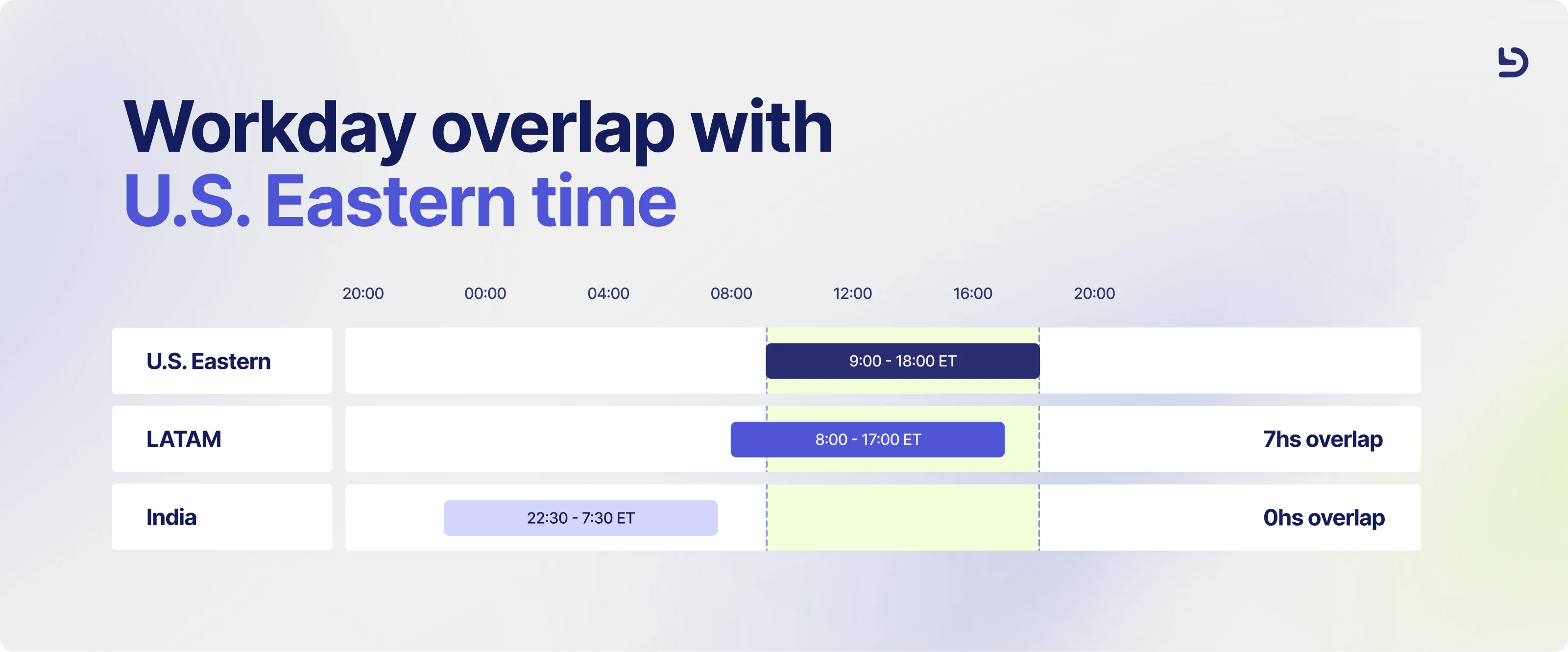
The time zone difference is easier to understand through an ordinary day of work.
With a LATAM team, a product manager in New York runs the morning standup with the whole team on the call. Questions that come up during code review get answered in minutes, a bug reported at 2 p.m. can be fixed and deployed the same afternoon, and planning sessions happen with everyone in the room.
With a team in India, the US team usually writes detailed tickets at the end of its day, the team in India works on them overnight, and the results arrive the next morning. This handoff model can work well for well-documented, predictable tasks, but any question or blocker adds a full day to the cycle unless someone joins calls very early or very late.
Total Cost Beyond the Hourly Rate
Comparing regions by hourly rate alone rarely shows the real cost of a team. Before deciding, factor in these costs as well.
- Rework: misunderstood requirements that are only discovered after a day's delay cost more to fix.
- Management overhead: asynchronous teams need more detailed specifications and more review time from US leads.
- Turnover: every engineer who leaves takes product context with them and restarts the hiring and onboarding cycle.
- Speed to market: shorter feedback loops usually mean features ship sooner.
For many US product teams, these factors close much of the gap between Indian and Latin American rates. You can estimate the numbers for your own roles with our Nearshore Savings Calculator.
LATAM vs India for US SaaS Startups: Cost, Time Zone and Hiring Speed
For a US B2B SaaS startup, the comparison usually comes down to three factors.
- Cost: India offers the lowest hourly rates, especially for junior roles. LATAM costs more per hour but still 40% to 60% less than US hires, and startups often need the senior profiles where LATAM is strongest.
- Time zone: startups ship fast and change priorities often, so same-day answers matter. LATAM teams join standups, demos and incident calls during US hours.
- Hiring speed: in both regions, hiring speed depends more on the partner than on the country. Ask each provider how long it takes from opening a search to an engineer's first commit, and whether it has a bench of vetted candidates.
Moving from an India Team to LATAM
Some US companies keep their India team and add LATAM engineers for work that needs daily collaboration. Others move a full function, such as QA or DevOps, from an India vendor to a LATAM partner. In both cases, a few practices make the transition smooth.
- Plan an overlap period so the outgoing and incoming teams work in parallel and transfer knowledge before the handover.
- Start with one area, such as QA, DevOps or a single product team, and expand once the new setup is stable.
- Match your legal protections. The new partner should offer IP assignment, invention rights and NDAs at least as strong as your current contracts, and employ engineers in a way that assigns their work to your company.
- Check security from day one, including managed devices, access controls and a verifiable certification such as ISO 27001.
Can You Combine Both Regions?
Some companies use a hybrid setup. They keep core product engineering in Latin America, where engineers join the US team's daily rituals, and place work that benefits from round-the-clock coverage, such as QA regression runs, monitoring or support, in India. This model works best when each team owns a clearly defined area, so handoffs between regions stay limited and well documented.
Why US Engineering Teams Choose LATAM over India
As US engineering teams move toward agile, highly collaborative workflows, more companies are shifting toward nearshore solutions. The ability to work in real time with skilled engineers who understand North American culture and business practices is a compelling advantage. Read more about why US companies hire Latin American developers.
Which Region Is Right for Your Business?
Choosing between LATAM and India for outsourcing ultimately depends on your business priorities and specific project needs.
LATAM offers proximity, cultural alignment, and real-time collaboration advantages, making it ideal for businesses in North America seeking seamless integration.
On the other hand, India provides access to a vast, cost-effective talent pool with a strong focus on tech and IT expertise, which suits companies looking to scale rapidly at a lower cost.
Evaluate factors such as time zones, communication, required expertise, and budget to make the best decision for your goals. If LATAM fits your needs, our guide to nearshore software development in LATAM covers costs, English levels and the hiring process, and our guide on how to choose the right nearshore partner in LATAM covers what to ask before you sign. Not sure which hiring model to use? Compare freelancers, staffing agencies and nearshore partners.
Ready to add senior LATAM engineers to your team? Devlane recruits, employs and supports developers across Latin America who work in US time zones as part of your team. Book a call or estimate your savings with our Nearshore Savings Calculator.
Want a structured way to compare providers? Download our guide, What to ask before choosing a staff augmentation partner.
Frequently Asked Questions
Is Latin America or India better for staff augmentation?
It depends on how your team works. Latin America fits US teams that need real-time collaboration, strong English and senior engineers. India fits large, well-documented projects where cost per hour matters more than daily overlap.
Is LATAM or India better for a US SaaS startup?
Most US SaaS startups lean toward LATAM because they ship fast, change priorities often and need senior engineers who can join daily standups. India can still be a good fit for well-defined work where cost per hour matters most.
What is the time difference between the US and India?
India is 9.5 to 10.5 hours ahead of US Eastern time and 12.5 to 13.5 hours ahead of US Pacific time, depending on daylight saving. Most Latin American countries are within three hours of US Eastern time.
How do you move an engineering team from India to LATAM?
Start with one function, such as QA or DevOps, plan an overlap period for knowledge transfer, and make sure the new partner matches your current IP assignment, NDA and security protections before the handover.
Can I combine teams in Latin America and India?
Yes. Some companies keep work that benefits from round-the-clock coverage, such as QA or support, in India and place core product engineering in Latin America, where engineers overlap with the US team during the day.

Other Blog Posts

What agentic AI means, and how to introduce it into your software development projects