Freelancers, Staffing Agencies, or Nearshoring: Which Is the Best Option for Staff Augmentation in LATAM?
Freelancers fit short, well-defined tasks. Staffing agencies fill seats quickly but rarely support engineers after placement. Nearshore partners cost more than both but handle vetting, payroll, hardware, security and retention, which makes them the stronger option for long-term product teams.
Key insights
- Freelancers: best for short, well-defined tasks you can review yourself.
- Staffing agencies: fill roles fast, but onboarding, equipment and retention stay with your company.
- Nearshore partners: vet, employ and support engineers who join your team full time and work in your time zone.
- Real cost: nearshore rates are higher than freelancers, but the gap closes once management, turnover and security are counted, and they still save 40% to 60% compared with US hires.
- Security: managed devices and certifications such as ISO 27001 are what give you real control over code and IP.
Scaling a software team is no small task, and the options for hiring can feel overwhelming. Should you go with freelancers, rely on staffing agencies, or partner with a nearshore company? Each model offers unique advantages and challenges, and the right choice depends on how long you need the capacity and how closely the new engineers will work with your team.
Pros and cons of hiring freelancers
Freelancers are independent professionals hired per project or per hour, usually through marketplaces or referrals. They can be a great choice for short-term or highly specialized work, but they come with notable risks for ongoing product development.
Pros of freelancers
- Flexible hiring. You can bring someone in for a few weeks and end the engagement when the task is done.
- Cost-effective for one-off tasks. You pay only for the hours or deliverables you need, with no long-term commitment.
- Large talent pool. Marketplaces give access to specialists in almost any technology.
Cons of freelancers
- Lack of commitment. Freelancers often juggle several clients, so availability and focus can change without notice.
- Inconsistent quality. Vetting falls on your team, and quality varies widely from one freelancer to the next.
- Minimal control over tools and security. Work usually happens on personal devices, outside your access policies.
Pros and cons of hiring staffing agencies
Staffing agencies find and preselect candidates for your open roles, usually charging a placement fee or a markup on the engineer's rate. They speed up hiring, but their involvement often ends once the seat is filled.
Pros of staffing agencies
- Quick access to candidates. Agencies keep databases of profiles and can share resumes within days.
- Reduced administrative burden. Some agencies handle contracts and payroll for the placed professional.
Cons of staffing agencies
- Limited technical and cultural vetting. Screening is often based on resumes and keywords rather than technical interviews.
- Short-term focus. Many agencies optimize for filling roles quickly, not for long-term fit.
- Minimal support after hiring. Onboarding, equipment, retention and performance stay with your team.
Pros and cons of nearshore companies
Nearshore companies recruit, employ and support engineers in nearby countries who join your team full time and work in your time zone. Nearshoring combines the best of both worlds, offering the quality of an in-house hire with the flexibility of outsourcing.
Pros of nearshore companies
- Rigorous screening. Technical interviews, English assessment and culture fit checks happen before you meet a candidate.
- Comprehensive services. Hardware provisioning, payroll, compliance and ongoing support are included.
- High retention and strong integration. Engineers work exclusively with your team and stay for the long term.
Cons of nearshore companies
- Higher rate than freelancers or agencies. The price includes services the other models leave to you, so the return is strongest for long-term projects.
When to choose each option
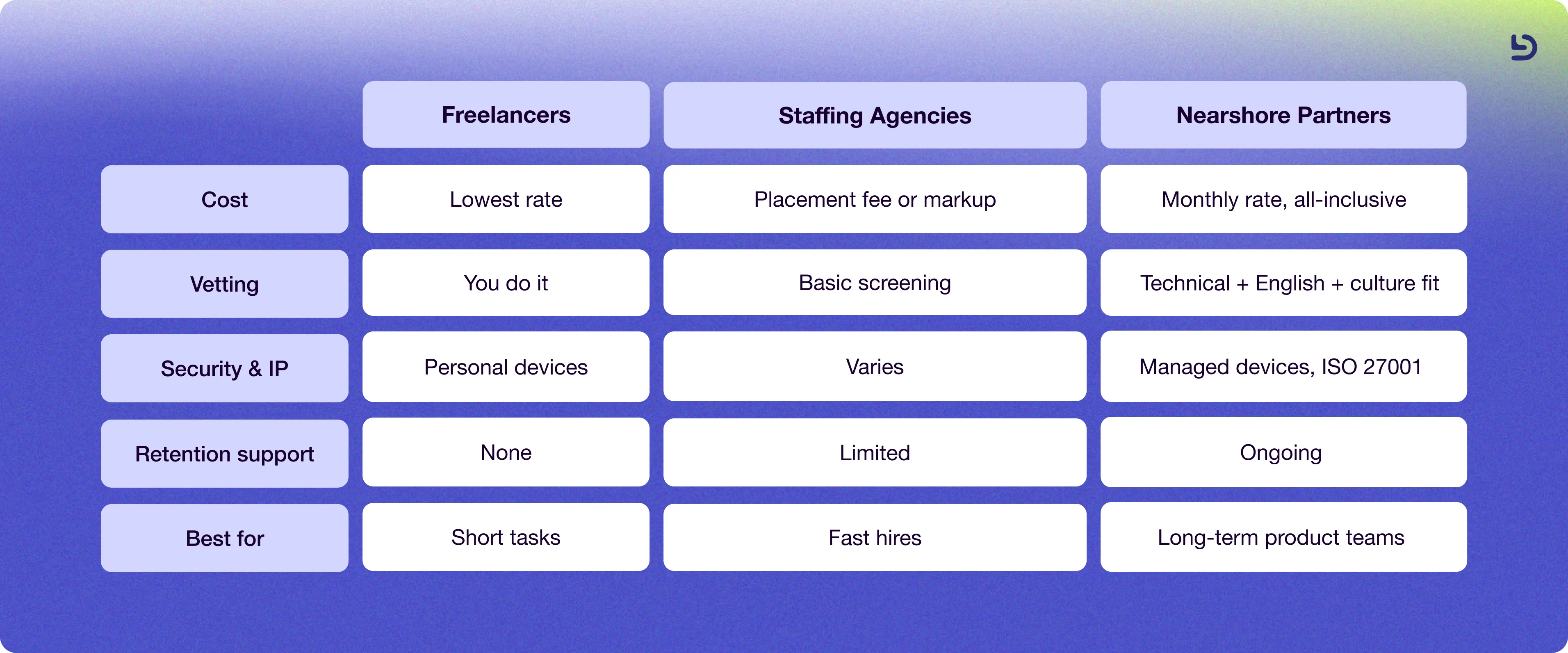
- Freelancers: short, well-defined tasks where you can review the output yourself.
- Staffing agencies: roles you need to fill quickly when your company can handle onboarding, equipment and compliance internally.
- Nearshore partners: long-term product teams that need vetted senior engineers, security and retention support.
If you are deciding between adding engineers to your team or handing off a full project, read outsourcing vs outstaffing.
The real cost of each model
The rate on the proposal is only part of what each model costs. Before comparing quotes, check what each one includes and what your team will still have to cover.
- Freelancers usually have the lowest rate, but your company covers recruiting time, vetting, equipment, security tooling and project management. If a freelancer leaves mid-project, you start the search again.
- Staffing agencies charge a placement fee or a markup on the engineer's rate. Onboarding, hardware, retention and day-to-day support usually stay with your company.
- Nearshore partners charge a monthly rate per engineer that typically includes recruitment, payroll, benefits, equipment, security and ongoing support. Compared with an equivalent US hire, US companies typically save 40% to 60%, as we explain in the real cost of hiring software engineers in the US vs Latin America.
For teams that will work together for more than a few months, the gap between models tends to shrink once you factor in management time, turnover and replacement costs. You can estimate the difference for your roles with our Nearshore Savings Calculator.
Security and intellectual property
Security is often the deciding factor for product companies. Freelancers typically work from personal devices, which makes it harder to enforce access policies, encrypt data or revoke access cleanly when the engagement ends. Agencies vary widely, and many leave device management to the client.
A nearshore partner with a certified information security program can provide managed devices, controlled access to your systems and clear contracts that assign intellectual property to your company from day one. Before signing with any provider, ask who owns the code, how access is granted and removed, and whether they hold an active certification such as ISO 27001.
What happens when someone leaves
Turnover is where the three models differ most. With a freelancer, you are back to square one, with a new search, new vetting and a new onboarding. Agencies may offer a replacement guarantee for a limited period, but knowledge transfer usually falls on your team. A nearshore partner tracks engagement, works on retention before problems escalate and handles the replacement process, often with candidates from an internal bench.
Can you combine models?
Yes, and many companies do. A common setup is a nearshore team that owns core product work, with freelancers brought in for short, specialized tasks such as a design sprint or a one-time integration. The key is to keep access to sensitive systems and long-term product knowledge within the team that will stay.
Why nearshoring stands out
Unlike freelancers or staffing agencies, nearshore companies like Devlane in LATAM provide end-to-end support for the engineers they place.
- Agility in finding the talent you need: Part of our recruitment efficiency is minimizing the time-to-hire. When a partner starts a search with us, we first offer ideal candidates from our internal bench, engineers with proven skills and experience. If necessary, our Talent Acquisition team begins a customized external search across our LATAM network to find the perfect fit.
- Effortless onboarding: Hardware delivery, preconfigured tools, and immediate readiness to start.
- Enhanced security: ISO/IEC 27001:2022 certified processes for managing data and protecting intellectual property.
- Talent retention: Dedicated career development plans to ensure long-term engagement and productivity. 85% of our engineers stay with their client teams.
- Less administrative burden for your company: Coverage of tax compliance, hiring costs, and payroll aligned with each country’s regulations. Handling of travel-related paperwork for developers attending corporate trips or training sessions. Management of PTO, sick leave, benefits, and rewards, along with smooth and secure offboarding processes.
Questions to ask before choosing a model
- How long will you need this capacity, weeks, months or years?
- Who on your team has time to recruit, vet and manage the new engineers?
- Will the engineers access sensitive data or production systems?
- How much daily collaboration with your in-house team does the work require?
- What happens to the project if someone leaves next month?
If most answers point to long-term work, sensitive access and daily collaboration, a nearshore partner is usually the safer choice.
Finding the right partner
Your outsourcing strategy depends on your business goals. For companies focused on scaling high-performing, secure, and cohesive teams, nearshoring offers unmatched advantages. Learn why US companies hire Latin American developers, and once you decide on a nearshore model, use our checklist for choosing a nearshore partner in LATAM.
Devlane works with US companies as a nearshore technology partner. Some teams bring us in to add senior LATAM engineers through staff augmentation, others to set up operational hubs in Latin America or to build a product end to end with custom software development. Book a call or estimate your savings with our Nearshore Savings Calculator. To compare providers in a structured way, download our guide, What to ask before choosing a staff augmentation partner.

Frequently asked questions
Is it better to hire freelancers or a nearshore company?
Freelancers work well for short, well-defined tasks. For long-term product work, a nearshore company is usually the safer choice because it handles vetting, payroll, hardware, security and retention, and replaces engineers if needed.
What is the difference between a staffing agency and a nearshore partner?
A staffing agency mainly finds candidates and steps back after placement. A nearshore partner employs the engineers, manages payroll, equipment and compliance, and supports retention throughout the engagement.
Are nearshore companies more expensive than freelancers?
Usually yes on rate, since the price includes recruitment, administration, equipment and ongoing support. For long-term teams the gap tends to close because of lower turnover, less management overhead and fewer security risks.
When should I use a staffing agency?
When you need to fill a role quickly and your company can handle onboarding, equipment, compliance and retention internally.

Other Blog Posts
Forward Deployed Engineer: What the Role Is and Why AI Is Driving Demand


Cybersecurity in the era of AI: what engineering leaders told us about AI agent security


What agentic AI means, and how to introduce it into your software development projects