
Scaling engineering teams today isn’t just about hiring more developers. It’s about doing it efficiently and without slowing down delivery.
For U.S. companies, that’s getting harder every year. Salaries are rising, hiring takes longer, and the real cost of an engineer goes far beyond compensation.
That’s why more companies are turning to nearshore staff augmentation in Latin America. Not just to reduce costs, but to build high-performing teams with speed, alignment, and long-term scalability.
In this article, we break down the real cost of hiring in the U.S., what the same talent costs in Latin America, the hidden savings most companies overlook, and why nearshore is quickly becoming the strategic default.
How much does it cost to hire a software engineer in the US
First things first. Hiring in the U.S. is expensive. Not because the talent is inherently better, but because of the economic context companies operate in.
According to the U.S. Bureau of Labor Statistics, the median annual salary for software developers reached $133,080 in 2024, while Glassdoor estimates the average closer to $148,861, with senior engineers often exceeding $250,000.
For companies that prioritize fully in-house teams, on-site collaboration, or have the budget to support it, this model can make complete sense. But it comes at a cost. And that cost goes far beyond salary.
Once you factor in employer-side costs, including health insurance, 401(k) contributions, payroll taxes, equipment, software licenses, and operational overhead, the fully loaded cost of a U.S. software engineer typically lands between 1.25x and 1.5x the base salary.
In practice, that means:
- A $140,000 salary becomes $175,000 to $210,000 per year
- Recruiting adds another $20,000 to $30,000 per hire
And even that does not capture the full picture.
The 2025 Stack Overflow Developer Survey reinforces how inflated the U.S. market has become compared to global benchmarks. While senior roles in the U.S. sit well above $130,000, the broader global developer market ranges between $60,000 and $85,000.
The takeaway is not that U.S. talent is better. It is that companies are paying a premium driven by local market conditions, not necessarily by differences in capability.
What about the same talent in Latin America?
If the cost of hiring in the U.S. is driven by market conditions, what happens when you look at the same roles in a different context?
The salary landscape in Latin America is significantly different. Not because the talent is less skilled, but because cost of living, tax structures, and market dynamics create a different economic reality.
The region has over 2.8 million tech specialists and produces more than 220,000 new STEM graduates each year, with strong English proficiency and deep alignment with U.S. business culture.
At the same time, Latin America’s IT services market is projected to reach $27.5 billion by 2026, reflecting the scale and growth of the region as a source of engineering talent for U.S. companies.
When you break it down by role, the difference becomes clear.
For example, a senior full-stack engineer in the U.S. can cost around $110/hour, while a comparable engineer in Latin America typically averages closer to $50/hour. Similarly, a mobile engineer in the U.S. may sit around $95/hour, compared to roughly $47/hour in LATAM. Even at the higher end of these ranges, the savings remain significant, typically between 40% and 60%, depending on the role and seniority.
When you work with a nearshore partner that consolidates payroll, compliance, and HR operations into a single engagement, the overall cost structure becomes simpler and more predictable compared to managing a distributed team internally.
Beyond salary: The total cost advantage
Cost and budget are only part of the equation. There are other factors that directly impact how engineering teams perform, and they should be considered when deciding how and where to hire talent for software development projects. Let’s look at some of them:
Time zone alignment and real-time collaboration
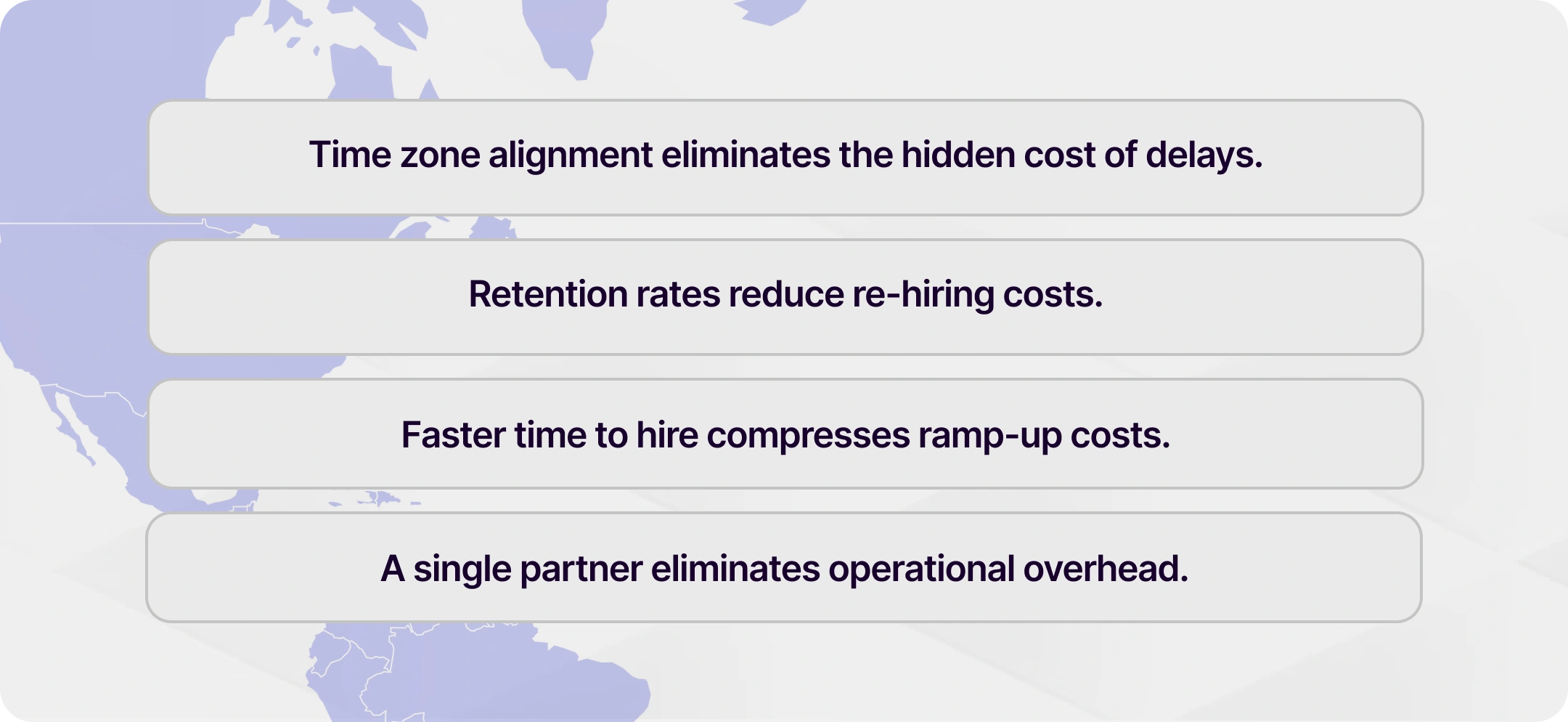
Latin American teams work in overlapping hours with U.S. companies, typically across EST to PST. This enables real-time collaboration on standups, same-day code reviews, and synchronous pair programming when needed.
This is not a minor operational detail. The cost of asynchronous communication with offshore teams compounds quickly. Blocked pull requests, misaligned sprint goals, and decisions that take 48 hours instead of 30 minutes can gradually impact delivery.
According to Deloitte's 2024 Global Outsourcing Survey, nearshore teams deliver projects 40% faster and achieve higher success rates compared to offshore models.
Team stability and long-term retention
High turnover is one of the biggest hidden expenses in engineering.
Every time a developer leaves, companies lose context, disrupt team velocity, and spend months backfilling the role. The Society for Human Resource Management estimates that replacing a technical employee can cost six to nine months of their salary in recruiting, onboarding, and lost productivity.
Nearshore models in Latin America, especially when supported by structured retention and engagement programs, tend to achieve higher retention rates, often above 80%. This is well above the U.S. tech industry average, which has hovered closer to 60% in recent years.
At Devlane, this is a core part of the model. Dedicated People Partners work closely with each engineer to support engagement, growth, and long-term alignment with client teams, helping achieve retention rates of around 85%.
Over time, this level of stability translates into fewer hiring cycles, stronger team continuity, and more consistent delivery.
Faster hiring and time to value
Hiring timelines directly affect execution. In the U.S., hiring a software engineer can take 45 to 60 days, followed by additional time for onboarding. During that period, teams absorb the impact through delayed features, stretched timelines, and increased workload.
Nearshore partners with established talent networks can place senior engineers in weeks, not months. This reduces ramp-up time and helps teams maintain momentum.
This is where having a specialized talent function makes a difference. At Devlane, technical recruiters work closely with each search, bringing hands-on understanding of specific tech stacks and role requirements, supported by an in-house talent network. This allows teams to move faster in identifying and validating candidates, without extending hiring cycles.
Faster hiring leads to faster delivery, and ultimately to faster impact on product and business outcomes.
Reduced operational complexity
Managing distributed engineering teams involves more than hiring. Payroll, compliance, legal frameworks, equipment, and ongoing HR support all require coordination, especially when operating across multiple countries.
Each of these elements adds operational overhead and requires internal resources to manage effectively.
In nearshore models, these responsibilities are often centralized through a single structure, which can simplify coordination and reduce the complexity of managing multi-country teams.
As a result, companies can spend less time on administrative processes and more time focused on engineering execution and product development.
What this means in practice
When you look at these factors together, the impact becomes easier to quantify.
A team of five senior engineers hired in the U.S. would cost approximately $875,000 to $1,050,000 per year in fully loaded compensation. The same team, built through a nearshore model in Latin America, would cost roughly $400,000 to $550,000 per year, including payroll, compliance, and operational support.
This represents a potential difference of $325,000 to $500,000 annually for a single team, without changes in seniority, English proficiency, or time zone alignment.
As teams scale, the impact becomes more significant. What starts as a cost consideration often becomes a structural advantage in how teams are built and operated.
Nearshore staff augmentation in Latin America is no longer an emerging approach. According to Deloitte reports, 80% of executives plan to maintain or increase investment in outsourcing, reflecting a broader shift in how companies scale engineering capacity.
The focus is not on finding the lowest cost option. It is on building teams that can move efficiently, collaborate in real time, and operate at a sustainable cost over time.
At Devlane, we have seen this shift firsthand. Over the years, we have supported companies at different stages, from startups to enterprise organizations, helping them scale engineering teams with nearshore talent in a way that aligns with their structure, pace, and long-term goals.
For companies looking to scale engineering without significantly increasing burn rate, Latin America is an option that should be equally considered and evaluated alongside traditional hiring models.


Other Blog Posts
.webp)
How to Build an AI Agent for Production