Every company wants to make smarter decisions with data. Yet many organizations still struggle with inconsistent reports, disconnected systems, and dashboards that tell different stories depending on who built them. The problem usually isn't the dashboard, but the data behind it.
A modern data warehouse gives organizations a single, reliable source of truth by consolidating information from multiple business systems into one structured environment. That foundation makes reporting more accurate, analytics more scalable, and AI initiatives significantly more effective.
As companies continue investing in data-driven decision-making and artificial intelligence, building the right data architecture has become a business priority.
Whether you're modernizing an existing analytics platform or building your first centralized data environment, understanding how data warehouses work is the first step toward making better business decisions.
Key insights
- A data warehouse centralizes information from multiple business systems into a single, trusted source of truth.
- As organizations grow, fragmented data across CRMs, ERPs, finance, marketing, and product systems becomes one of the biggest barriers to reliable reporting and decision-making.
- Dashboards are only as reliable as the data they visualize. Strong data architecture matters more than visualization tools alone.
- According to Gartner, poor data quality costs organizations an average of $12.9 million every year, highlighting the business impact of inconsistent and unreliable data.
- A well-designed data warehouse provides the clean, standardized, and historical data needed to support business intelligence, analytics, and modern AI initiatives.
What is a data warehouse?
A data warehouse is a centralized repository that collects, organizes, and stores data from multiple sources in a structured format optimized for reporting, analytics, and business intelligence.
Unlike operational databases, which are designed to process day-to-day transactions, a data warehouse is built specifically to answer business questions.
Instead of storing only what's happening right now, it preserves historical information from across the organization, allowing teams to analyze trends, measure performance, and make decisions based on consistent, validated data.
For example, rather than keeping customer information separated across a CRM, marketing platform, ERP, payment system, and customer support software, a data warehouse combines that information into a single environment where it can be analyzed together.
The result is a shared version of the truth that every department can trust.

Why go companies use data warehouses?
As organizations grow, so does the number of systems they rely on. For example, the sales teams work inside CRMs, the marketing teams analyze campaign performance across multiple platforms and finance manages accounting software. Each of these platforms generates valuable information. The challenge is that they were never designed to communicate seamlessly with one another.
Without a centralized data platform, different departments often calculate the same business metrics differently. Leadership ends up spending more time debating which numbers are correct than deciding what to do next.
A data warehouse solves this problem by consolidating information, standardizing definitions, and making reliable data available across the organization.
Why companies struggle with data
Most companies don't have a data problem, but they do have a data fragmentation problem. Over the last decade, organizations have rapidly adopted specialized software for nearly every business function. While each tool solves an individual problem, together they create a complex ecosystem where information becomes increasingly difficult to manage.
A typical technology company may rely on:
- HubSpot for CRM and marketing automation
- Stripe for payments
- NetSuite for finance
- Jira for engineering
- Zendesk for customer support
- Snowflake or BigQuery for analytics
- Internal applications that generate proprietary operational data
Every platform stores information differently and customer names may not match across systems. Revenue may be calculated using different business rules, dates may use different formats and probably some data updates in real time, while other datasets refresh only once per day.
As the business grows, these inconsistencies multiply and confidence in the organization's data starts to decline. Ironically, companies often respond by purchasing better reporting tools, but visualization platforms don't solve data quality problems. They simply make those problems easier to see.
According to Gartner, poor data quality costs organizations an average of $12.9 million every year, highlighting how inconsistent and unreliable information directly impacts business performance.
More data doesn't always mean better decisions
One of the biggest misconceptions in modern analytics is that collecting more data automatically leads to better business outcomes. In reality, more data often creates more complexity.
Organizations now generate information from cloud applications, mobile devices, APIs, IoT sensors, customer interactions, financial systems, and increasingly, AI-powered products. Without a consistent architecture, this growing volume of information quickly becomes difficult to govern.
The scale of this challenge is only increasing. IDC projects that the global datasphere will reach nearly 394 zettabytes by 2028, making scalable data architectures essential for organizations that want to transform growing volumes of information into business value.
Duplicate records, missing values, inconsistent definitions, and disconnected datasets reduce trust in reporting and slow down decision-making. This is why successful data strategies don't begin with dashboards, they begin with architecture.
A well-designed data warehouse creates the structure needed to transform scattered information into reliable business intelligence, ensuring that every report, dashboard, and AI application is built on the same trusted foundation.
How a data warehouse solves the problem
A data warehouse doesn't replace the systems your business already uses. Instead, it connects them. Rather than asking every department to work inside the same application, a data warehouse continuously gathers information from multiple sources, cleans it, standardizes it, and stores it in a format optimized for analytics.
This process creates a single, trusted environment where business leaders can answer questions without worrying about where the data came from or whether different teams are using different definitions.
A simplified workflow typically looks like this:
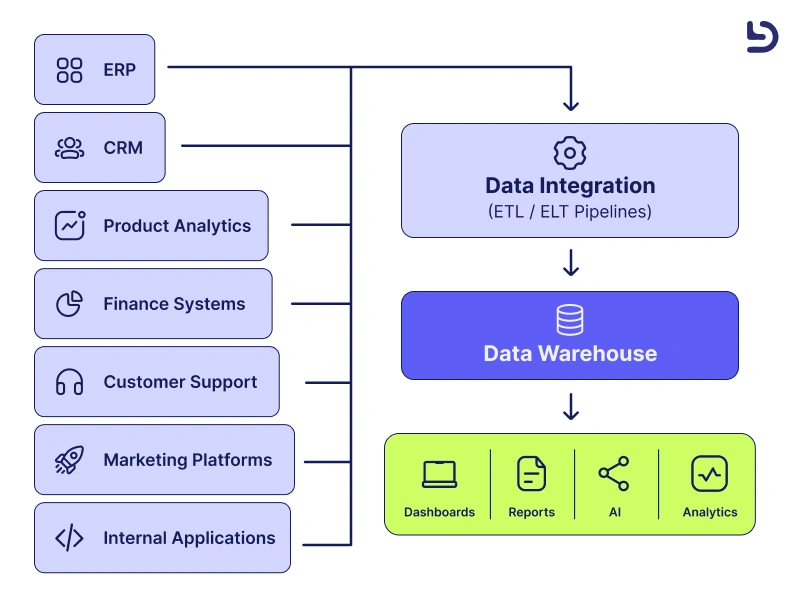
Instead of dozens of disconnected datasets, the organization now has a centralized platform that everyone can rely on.
The core components of a modern data warehouse
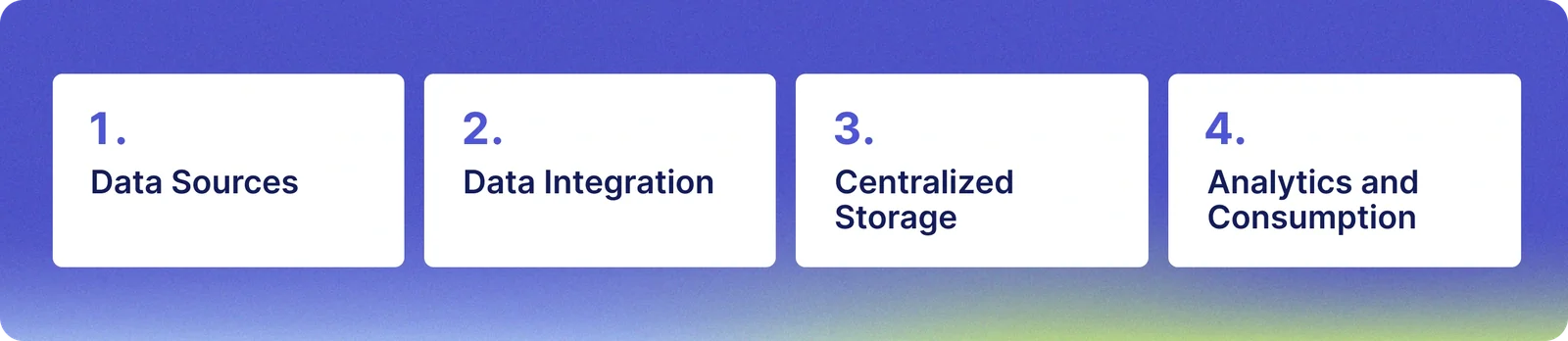
Although every implementation is different, most modern data warehouses are built around four fundamental layers.
1. Data Sources
The first layer consists of the systems that generate operational data. These can include CRMs, ERP platforms, financial software, product analytics tools, cloud applications, internal databases, APIs, and even IoT devices. Each source contains valuable information, but each speaks a different "language."
2. Data Integration
Once data is collected, it must be transformed into a consistent format. This is where ETL (Extract, Transform, Load) or ELT (Extract, Load, Transform) pipelines come into play. These pipelines remove duplicate records, standardize naming conventions, validate information, and combine data from multiple systems into unified business entities.
For example, a customer who appears under slightly different names across five systems becomes a single customer record inside the warehouse. Without this layer, reporting quickly becomes unreliable.
3. Centralized Storage
After transformation, the cleaned data is stored inside the warehouse. Unlike operational databases, which prioritize transaction speed, warehouses are optimized for complex analytical queries involving millions (or even billions) of records. Because historical information is preserved, organizations can analyze trends over months or years instead of looking only at current operational data.
4. Analytics and Consumption
Finally, the business consumes the information. Executives review dashboards, analysts build reports, finance measures profitability and operations identifies bottlenecks.Every decision is based on the same underlying data.
Data Warehouse vs. Data Lake
As organizations modernize their data infrastructure, another concept often appears alongside data warehouses: data lakes. Although they're often mentioned together, data warehouses and data lakes solve different problems.
A data warehouse stores structured, curated information that's ready for reporting and business analysis.
A data lake, on the other hand, stores massive amounts of raw data before it has been cleaned or organized.
Neither approach is inherently better, they simply serve different purposes.
| Data Warehouse | Data Lake |
|---|---|
| Stores structured, processed data | Stores raw structured and unstructured data |
| Designed for business reporting | Designed for exploration and advanced analytics |
| Optimized for SQL queries | Supports multiple processing frameworks |
| Used primarily by business users and analysts | Used primarily by data engineers and data scientists |
| Delivers consistent business metrics | Supports experimentation and machine learning |
| High governance and data quality | Flexible schema with fewer constraints |
Many organizations use both. The data lake acts as the organization's raw data repository, while the data warehouse provides the curated information used for daily business decisions. Rather than competing architectures, they often complement one another.
Why architecture matters more than dashboards
One of the most common misconceptions in analytics is believing that better dashboards automatically produce better decisions, but they don't. Dashboards simply visualize whatever data they're given.
If customer information is duplicated, revenue calculations are inconsistent, or business definitions vary between departments, those problems don't disappear when displayed in a visualization tool.
Whether your organization uses Tableau, Microsoft Power BI, Looker, Sigma, or another business intelligence platform, the quality of every chart depends entirely on the quality of the underlying data.
A dashboard can answer questions but it cannot fix the information it receives. This is why successful analytics initiatives begin with architecture.
A practical example
Imagine a company's CEO asks a simple question:
"How many active customers do we currently have?"
It sounds straightforward, but different teams may produce completely different answers because marketing may exclude inactive subscribers, sales counts anyone who signed a contract and customer Success only includes paying customers.
Each report is technically correct according to its own definition, yet the organization still lacks a single answer. A properly designed data warehouse solves this by establishing standardized business definitions that every report uses consistently. Instead of debating numbers, teams can focus on improving them.
Why AI depends on a strong data foundation
Artificial intelligence has changed how organizations think about data. Companies are deploying AI copilots, intelligent search, predictive analytics, recommendation engines, and autonomous agents faster than ever before. Yet many AI initiatives fail for the same reason traditional analytics projects fail: the underlying data isn't ready.
Large Language Models, machine learning algorithms, and AI agents all depend on accurate, consistent, and well-governed information. If customer records are duplicated, financial metrics are inconsistent, or business definitions vary across departments, AI systems inherit those same problems.
The result isn't just inaccurate reporting, it's inaccurate decision-making. This is why many organizations discover that their biggest AI investment isn't the model itself, but the data architecture that supports it.
AI doesn't replace a data warehouse
Many organizations assume that modern AI can eliminate the need for traditional data platforms. In reality, the opposite is true. AI performs best when it can access structured, reliable, and contextualized information. A well-designed data warehouse provides exactly that.
Instead of spending computational resources cleaning inconsistent datasets every time a question is asked, AI applications can retrieve validated business information that's already been standardized.
Whether you're building an internal chatbot, implementing Retrieval-Augmented Generation (RAG), training predictive models, or deploying AI agents, the quality of your outputs will depend heavily on the quality of your data.
Final Thoughts
Every organization generates data. The companies that outperform their competitors aren't necessarily the ones collecting the most information but the ones creating the strongest foundation to use it effectively.
A well-designed data warehouse creates consistency across departments, increases confidence in business metrics, accelerates analytics, and prepares organizations for the next generation of AI-powered applications.
As data volumes continue to grow and artificial intelligence becomes embedded in everyday business operations, investing in modern data architecture is becoming a competitive advantage.
Wondering whether your organization actually needs a data warehouse? Read this blog, where we explain the warning signs, common implementation mistakes, and how to know when it's time to invest in a modern data platform.
At Devlane, we help companies build high-performing data engineering teams across Latin America, giving them access to senior specialists in Data Engineering, Analytics Engineering, Cloud Infrastructure, Business Intelligence, and AI. Whether you're modernizing an existing data warehouse or building a new analytics platform from scratch, our engineers work as an extension of your team, helping you design, build, and scale modern data platforms.

Frequently Asked Questions
What is a data warehouse in simple terms?
A data warehouse is a centralized repository that combines information from multiple business systems into one structured environment for reporting, analytics, and decision-making.
What is the difference between a data warehouse and a database?
Operational databases are designed to process day-to-day transactions quickly. Data warehouses are optimized for analyzing large volumes of historical data and generating business insights.
What is the difference between a data warehouse and a data lake?
A data warehouse stores structured, curated information ready for business analysis, while a data lake stores raw structured and unstructured data for exploration, advanced analytics, and machine learning.
Can a data warehouse support AI initiatives?
Yes. Modern AI applications, including AI copilots, Retrieval-Augmented Generation (RAG), predictive analytics, and intelligent agents, perform significantly better when they access structured, validated, and well-governed data from a centralized platform.
How long does it take to build a data warehouse?
The timeline depends on the number of systems involved, data complexity, and business requirements. Many organizations begin delivering value within a few months by prioritizing high-impact use cases and expanding incrementally.

Other Blog Posts
.webp)
How to Build an AI Agent for Production