.webp)
Most organizations don't wake up one day needing a data warehouse. Instead, the need grows gradually. Teams adopt new software, data spreads across multiple systems, reports become increasingly difficult to trust, and business decisions take longer than they should.
At some point, adding another dashboard or spreadsheet no longer solves the problem, and that's usually when organizations begin evaluating a data warehouse. In this blog, we'll cover the most common signs your business is ready for one, the mistakes to avoid during implementation, and the capabilities needed to build a modern data platform.
If you're unfamiliar with data warehouses, we recommend starting with our blog: What Is a Data Warehouse? Everything Businesses Need to Know. It explains the fundamentals of modern data warehouses, how they work, and why they play a central role in analytics, business intelligence, and AI.
Key Insights
- Growing organizations often outgrow spreadsheets long before they realize they need a data warehouse.
- Fragmented data slows reporting, reduces trust in business metrics, and limits AI initiatives.
- Successful data warehouse projects start with high-impact use cases, not every data source at once.
- Technology alone doesn't guarantee success. Governance, data quality, and scalable architecture matter just as much.
- Modern data platforms combine data engineering, analytics engineering, governance, BI, and cloud infrastructure.
Signs your business needs a Data Warehouse
While every organization is different, there are several common indicators that suggest it may be time to move beyond disconnected systems and build a centralized data foundation.
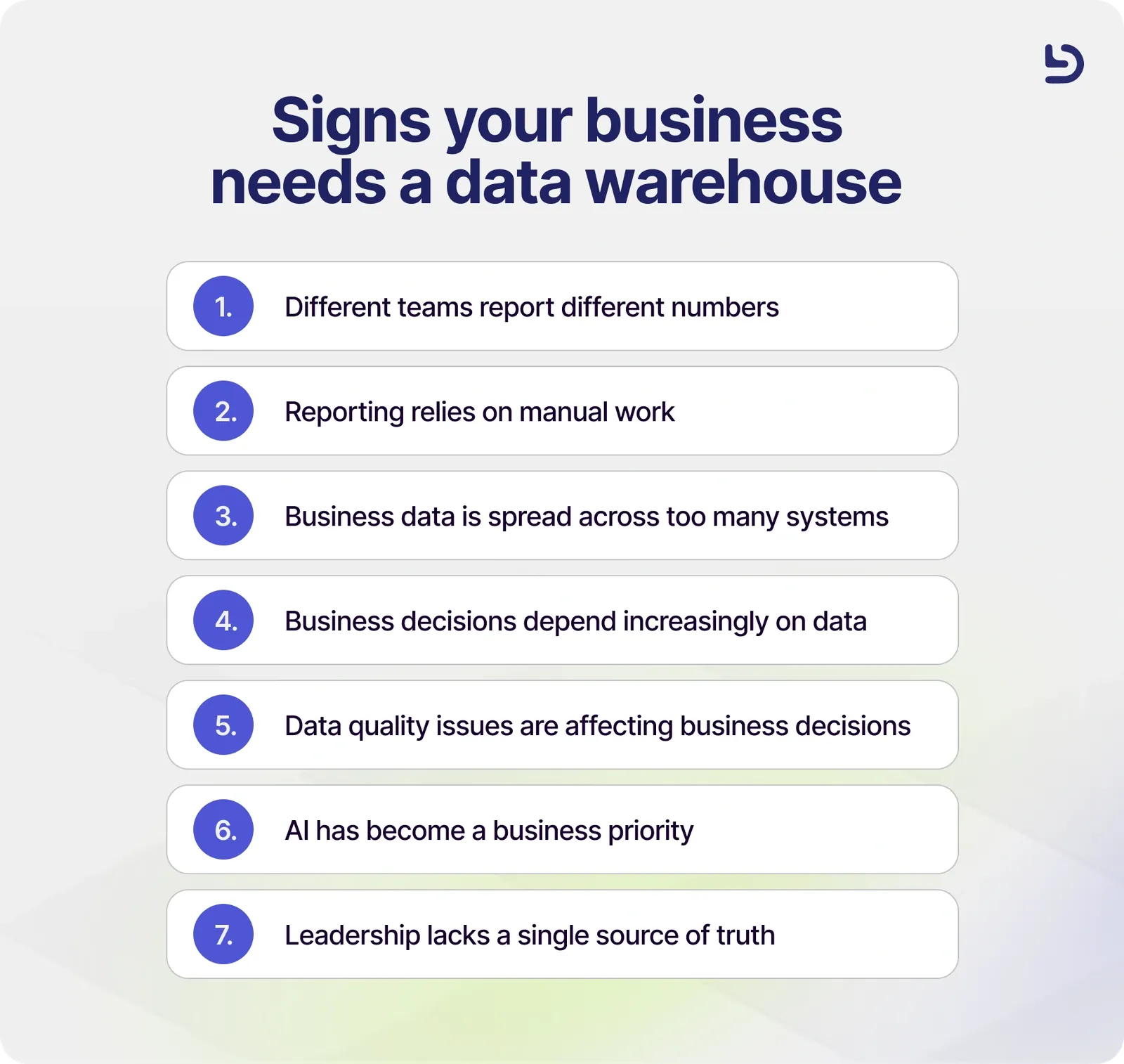
1. Different teams report different numbers
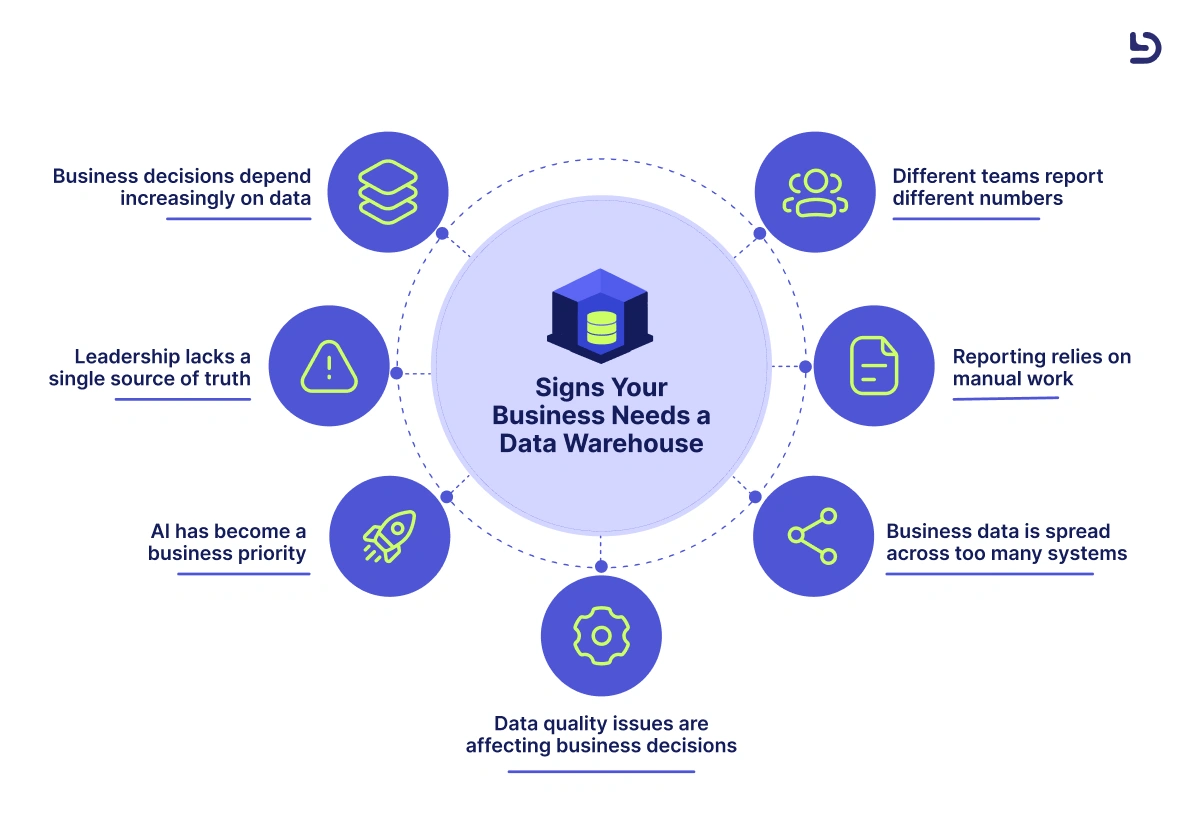
One of the earliest signs is when departments produce different answers to the same business question. Sales, Finance, Marketing, and Customer Success may each calculate revenue, active customers, or churn using different definitions and data sources. When business leaders spend more time reconciling metrics than acting on them, it's often a sign that the organization lacks a single source of truth.
2. Reporting relies on manual work
As businesses grow, reporting often becomes increasingly dependent on spreadsheets, manual exports, and repetitive data preparation. Teams spend hours combining information from multiple platforms before they can begin analyzing performance.
3. Business data is spread across too many systems
Modern organizations rely on dozens of applications to run their operations. Customer information may live in a CRM, financial records in an ERP, product usage in analytics platforms, and support interactions in customer service tools. Each system provides valuable information independently, but without a centralized architecture, building a complete picture of the business becomes increasingly difficult.
4. Business decisions depend increasingly on data
As organizations grow, data becomes part of everyday decision-making across every department. Leadership relies on performance dashboards, Finance forecasts future revenue, Marketing measures campaign performance, and Product teams analyze user behavior. Without a reliable data foundation, making timely and confident decisions becomes increasingly difficult.
5. Data quality issues are affecting business decisions
Duplicate customer records, inconsistent naming conventions, missing information, and conflicting business metrics reduce confidence in reporting. Over time, these issues can slow decision-making and make it difficult for leadership to trust the data they're using.
6. AI has become a business priority
Organizations investing in AI often discover that their biggest challenge isn't selecting the right model but preparing the underlying data. Whether the goal is predictive analytics, internal copilots, recommendation engines, or AI agents, reliable outputs depend on structured, standardized, and well-governed information.
7. Leadership lacks a single source of truth
Perhaps the clearest sign is when executives no longer have complete confidence in the organization's reporting. If every strategic discussion begins by questioning the numbers rather than interpreting them, the underlying data architecture may no longer support the needs of the business. A data warehouse provides the consistency, historical context, and shared business definitions required to support confident decision-making.
Characteristics of a well-designed data warehouse
Building a successful data warehouse involves much more than selecting the right cloud platform. The most successful implementations share a set of architectural principles that improve scalability, reliability, and long-term business value.
A well-designed data warehouse typically includes:
- Clear business definitions shared across departments.
- Scalable architecture capable of handling increasing data volumes.
- Automated ETL or ELT pipelines.
- High data quality through validation and monitoring.
- Strong governance policies defining ownership and access.
- Historical data retention for long-term analysis.
- Security and compliance controls that protect sensitive information.
- Documentation that makes datasets understandable across teams.
These characteristics reduce operational complexity while increasing confidence in every report generated across the organization. Ultimately, a data warehouse isn't just a technology project, it's an organizational system for creating consistency, trust, and better decision-making.
Common data warehouse design mistakes
Building a data warehouse is a long-term investment, but many projects fail to deliver the expected value, because of the decisions made during implementation. Understanding the most common pitfalls can help organizations avoid costly rework and build a platform that scales with the business.
1. Trying to centralize everything at once
One of the biggest mistakes is attempting to integrate every data source into the warehouse from day one. While the goal of a centralized data platform is valid, trying to migrate dozens of systems simultaneously often leads to delays, budget overruns, and low user adoption.
Successful organizations usually start with a small number of high-impact business cases, such as executive reporting or customer analytics, and expand incrementally as the platform matures.
2. Ignoring data governance
Technology alone doesn't create reliable data. Without clear ownership, validation rules, and standardized business definitions, even the most sophisticated architecture will eventually become inconsistent.
Data governance establishes who owns each dataset, how quality is monitored, who can access sensitive information, and how key business metrics should be calculated. Strong governance creates trust, and trust is what turns data into a strategic asset.
3. Focusing only on technology
Choosing between Snowflake, BigQuery, Amazon Redshift, or Microsoft Fabric is important, but technology is rarely what determines the success of a data initiative.
Successful projects align business objectives, data architecture, engineering practices, and organizational processes. The best platform is the one that supports your business goals, not necessarily the one with the longest feature list.
4. Poor data quality
For example, duplicate customer records, missing values, outdated information or inconsistent naming conventions. These issues may seem minor individually, but together they erode confidence in reporting.
When business leaders stop trusting dashboards, they often return to spreadsheets and manual reporting, eliminating much of the value the data warehouse was meant to create. Data quality should be monitored continuously rather than treated as a one-time cleanup effort.

5. Designing for today's needs only
A warehouse designed only for current reporting requirements may become difficult, or expensive, to scale later. Building with flexibility in mind, for new products launch or growing data volumes, helps organizations adapt without constantly rebuilding their analytics infrastructure.
Building a modern data platform
A data warehouse is the foundation of modern analytics, but it's only one part of a broader data ecosystem. Building a modern data platform requires multiple disciplines working together to transform operational data into reliable business insights.
Data Engineering: Designing reliable pipelines that collect, transform, and deliver data from operational systems into analytical environments.
Cloud Engineering: Building scalable cloud infrastructure capable of processing growing data volumes efficiently and securely.
Analytics Engineering: Creating semantic models that make complex datasets understandable and accessible for business users.
Business Intelligence: Developing dashboards and reports that transform trusted data into actionable insights.
Data Governance: Defining policies for ownership, quality, security, compliance, and lifecycle management.
Automation: Reducing manual work through automated pipelines, monitoring, validation, and orchestration.
Together, these capabilities create a scalable data platform that supports reporting, analytics, automation, and AI as the business continues to grow.
Building these capabilities often requires a multidisciplinary team. Organizations typically combine expertise in Data Engineering, Analytics Engineering, Cloud Infrastructure, Business Intelligence, Data Governance, and Automation to design, implement, and continuously evolve modern data platforms. At Devlane, we help companies build multidisciplinary data teams with expertise across modern data platforms, cloud ecosystems, analytics tools, and AI technologies. Our engineers bring hands-on experience designing, building, and scaling data solutions that support reporting, analytics, and AI initiatives.
Final Thoughts
Every growing organization eventually reaches a point where spreadsheets, disconnected systems, and manual reporting are no longer enough. The challenge isn't collecting more data, it's creating a reliable foundation that allows the business to use it effectively.
Recognizing the signs early helps organizations avoid costly rework, improve reporting, and build a data platform that can scale alongside the business. More importantly, it creates the consistency and trust required to support advanced analytics and future AI initiatives.
Whether your next step is implementing a data warehouse, improving data quality, or preparing your organization for AI, investing in the right data foundation today will make every future initiative more successful.

Frequently Asked Questions
Does every business need a data warehouse?
No. Many small organizations can operate successfully using operational databases and basic reporting tools. The need for a data warehouse usually emerges as data volumes, business complexity, and reporting requirements grow.
What's the biggest sign a business needs a data warehouse?
One of the clearest indicators is when teams spend more time collecting, validating, and reconciling data than analyzing it. Inconsistent metrics, disconnected systems, and manual reporting are also common signs.
How long does it take to implement a data warehouse?
The timeline depends on the number of data sources, business requirements, and implementation approach. Many organizations begin with a limited number of high-impact use cases and expand the platform incrementally over time.
What are the biggest mistakes companies make?
Trying to centralize every data source at once, neglecting data governance, treating data quality as a one-time project, and designing only for current business needs are among the most common reasons data warehouse initiatives fail to deliver long-term value.
Can a data warehouse support AI initiatives?
Yes. AI applications depend on reliable, standardized, and well-governed data. A well-designed data warehouse provides the foundation needed to support predictive analytics, AI copilots, recommendation engines, Retrieval-Augmented Generation (RAG), and other modern AI use cases.

Other Blog Posts
.webp)
How to Build an AI Agent for Production