.webp)
Engineering teams are expected to move fast, adapt constantly, and deliver high quality software under increasingly complex conditions, but the way developers experience their day to day work has a direct impact on how well those teams can perform.
That is where Developer Experience becomes important. The tools, processes, communication, documentation, and technical environment surrounding engineers can either help them move forward or create friction at every step.
I have always seen a parallel between preparing an engineering team and preparing a football team. In both cases, performance depends on much more than the people who step onto the field. The environment, preparation, communication, and support around them all shape what they are able to do.
Every weekend across youth flag football leagues, coaches and parents arrive before kickoff to prepare the field, organize equipment, check that everything is ready, and make sure the players have what they need to focus on the game. A lot of effort happens before anyone starts playing, and that preparation has a direct impact on what happens on the field.
I see that same dynamic in my work as a Technical Account Manager, where I spend much of my time between developers, technical leaders, clients, and business stakeholders. Over time, I have seen how much the environment surrounding engineering work influences the way a team performs.
Key insights
- Developer Experience has a direct impact on delivery, collaboration, and developer productivity.
- Many engineering problems come from friction around the work, including unclear requirements, slow feedback loops, poor documentation, and excessive dependencies.
- The strongest teams give developers enough context, autonomy, and focus to make good technical decisions.
- Improving DevEx often starts with small operational changes that remove recurring blockers from everyday work.
- Measuring Developer Experience requires combining delivery metrics with qualitative feedback on cognitive load, feedback loops, and flow state.
What is developer experience?
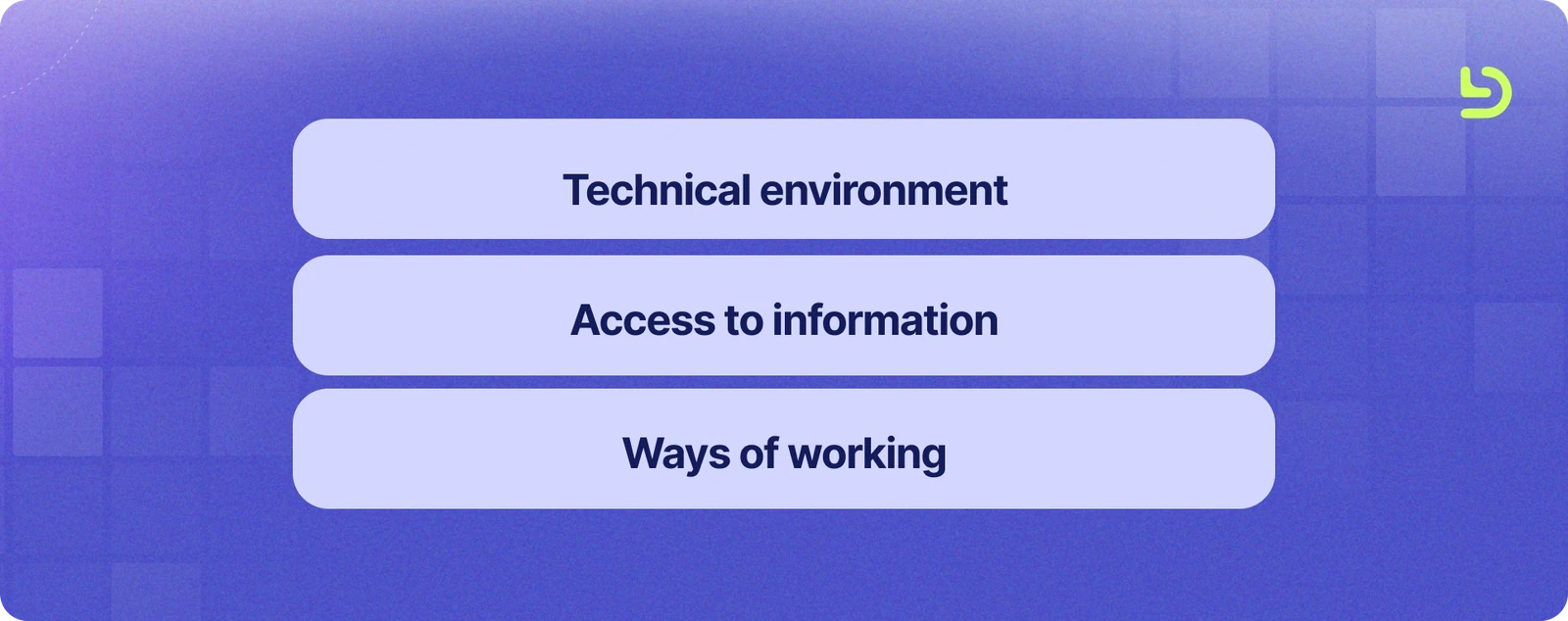
So, what is developer experience in practical terms? Developer Experience, commonly referred to as DevEx, describes how engineers experience the systems and processes involved in building software. It includes the technical environment, access to information, development workflows, communication practices, team dependencies, and the level of context developers receive when they are asked to solve a problem.
Many general employee experience examples focus on workplace benefits, flexibility, communication, or organizational culture. For developers, those elements still matter, but the engineering environment adds another layer. A developer may have a positive relationship with the company and still have a frustrating daily experience if basic engineering workflows create constant obstacles.
When I look at DevEx across different teams, I usually think about three broad areas:
A good employee experience framework for engineering teams should consider all three areas because the quality of the technical environment and the quality of the organizational environment are closely connected.
The role of employee experience in engineering
When people ask why is employee experience important in engineering, the conversation often starts with retention, engagement, or satisfaction. Those outcomes matter, but there is another dimension that engineering leaders need to consider. The daily experience of developers also influences how efficiently software moves from an idea into production.
This is one reason why focus on employee experience should be part of an engineering conversation and not only an HR conversation. Developers can have strong technical skills and still lose significant time waiting for environments, clarifying requirements, searching for information, troubleshooting unreliable pipelines, or depending on other teams before they can move forward.
Traditional productivity metrics rarely capture that complexity. The number of commits, lines of code, or tickets completed gives an incomplete picture of whether an engineering team is operating effectively. Developer productivity is influenced by how quickly people can understand a problem, make a decision, test their work, receive feedback, and ship a change.
In my experience, some delivery issues that initially appear to be technical problems are actually signs of friction in the environment around the team. Understanding those friction points is an important part of enhancing the employee experience because repeated blockers can increase cognitive load, create frustration, slow collaboration, and make good engineers feel less effective.
A strong workplace experience strategy for an engineering organization should pay attention to these everyday conditions and make it easier for people to concentrate on the work that requires their expertise.
Developer experience challenges I see across engineering teams
Working closely with different engineering organizations has allowed me to recognize patterns across teams with very different stacks, architectures, and processes. The challenges are not always identical, but many of the same friction points tend to appear repeatedly.
These are some of the Developer Experience challenges I see most often, along with the areas teams can focus on to address them.
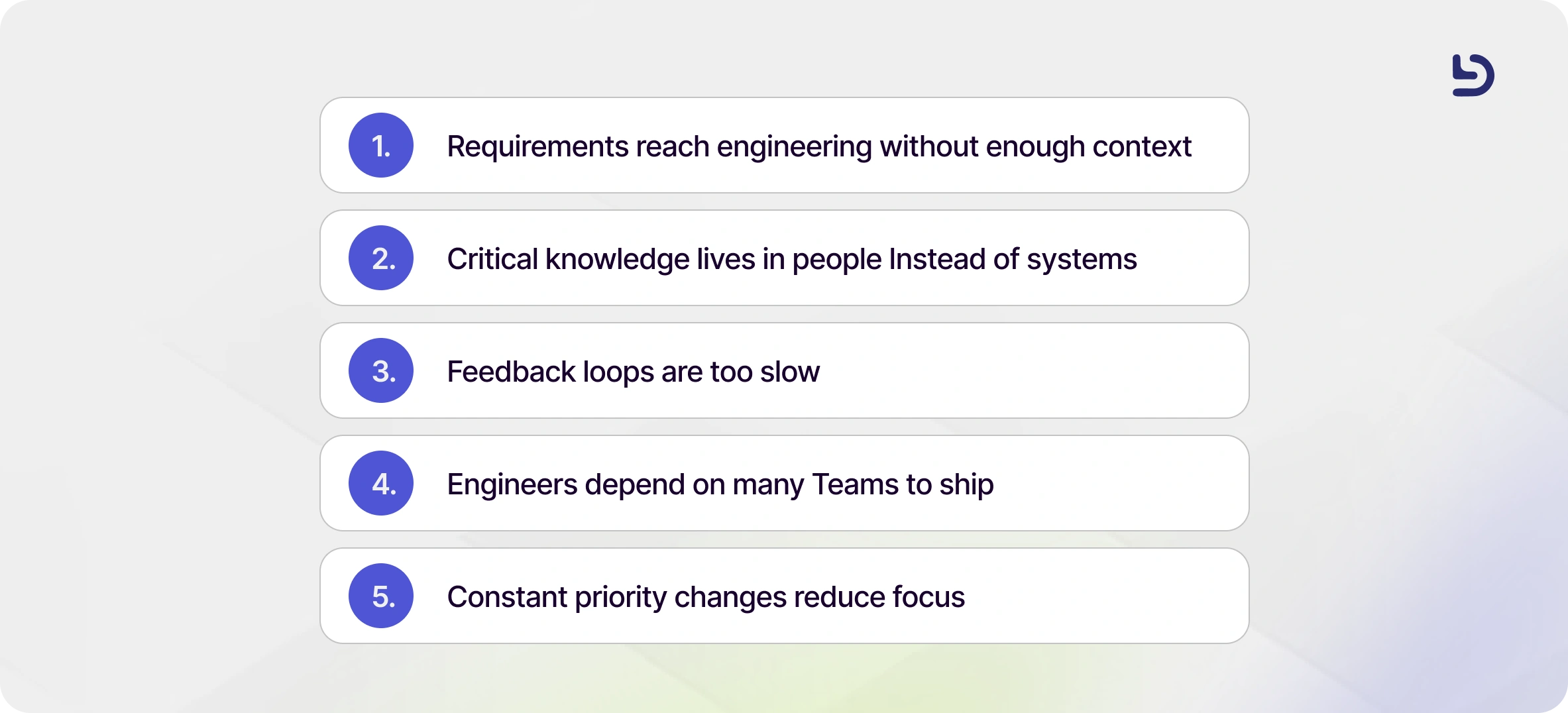
1. Requirements reach engineering without enough context
One of the most common issues is the gap between business intent and technical execution. A ticket may describe a feature or change without giving engineers enough context about the business objective behind it.
When developers understand only what they have been asked to build, they have less information to evaluate whether the proposed solution is the best one. That can lead to additional clarification, unnecessary rework, or a technically correct feature that still fails to address the original problem.
As a Technical Account Manager, I spend a lot of time helping connect those two sides. When engineers understand the objective, constraints, and expected outcome, they can participate more effectively in shaping the solution and identifying technical alternatives.
This is one area where an organization can improve employee experience and software delivery at the same time. Clearer context gives engineers more autonomy and reduces avoidable back and forth.
2. Critical knowledge lives in people instead of systems
Another pattern I see frequently is important technical knowledge concentrated in a small number of people. Senior engineers often have a deep understanding of how the architecture evolved, why certain decisions were made, and how different parts of the system interact.
When that knowledge is shared intentionally, it can become a major strength for the whole team. At Devlane, our senior engineers bring that mindset into client teams, contributing their experience while also helping other developers understand the reasoning behind technical decisions and ways of working.
This becomes especially valuable when working alongside less experienced developers on the client side. Rather than keeping expertise concentrated in a few people, senior engineers can help raise the technical level of the broader team through collaboration, documentation, code reviews, and day to day knowledge sharing.
The same principle applies to documentation. Important decisions, ownership, architecture, and technical context should be easy to find so that knowledge can continue to circulate across the team. The more accessible that context becomes, the easier it is for developers to make decisions independently and keep moving forward.
3. Feedback loops are too slow
Software development depends on continuous feedback. Developers run tests, open pull requests, wait for CI checks, request reviews, deploy changes, and observe how those changes behave in real environments.
When any part of that process becomes slow or unreliable, engineering work becomes fragmented. A pipeline that fails intermittently, a review that stays blocked for several days, or an environment that takes too long to provision can significantly affect how quickly a developer moves through a task.
One question I often find useful is: Where is the engineering team spending time waiting? The answer usually reveals important DevEx issues because waiting time often points directly to bottlenecks in tools, processes, approvals, or team dependencies.
4. Engineers depend on many teams to ship
Cross team collaboration is inevitable in complex software organizations, but excessive dependencies can make even small changes difficult to deliver.
A developer may complete the implementation of a feature and still need another team to configure infrastructure, approve permissions, make a related service change, create an environment, or handle deployment. When this happens repeatedly, teams lose autonomy and delivery becomes harder to predict.
I have also seen organizations respond to these problems by introducing additional processes and approvals, which can increase friction even further. In many cases, a better approach is to clarify ownership and identify which recurring tasks can become self service.
Internal platforms, standardized tooling, and clearer ownership models can help development teams perform routine tasks safely without depending on another team every time.
5. Constant priority changes reduce focus
Engineering work often requires sustained attention because developers need to keep many parts of a system in mind while reasoning through a problem. When people are constantly switching between unrelated tasks, urgent requests, meetings, and shifting priorities, that mental context has to be rebuilt repeatedly.
The strongest high performing engineering teams I have worked with usually have clear priorities and enough stability for developers to complete meaningful blocks of work. They still respond to incidents and changing business needs, but they also protect the concentration required for complex engineering tasks.
This is why meeting culture, communication practices, and priority management should be part of any conversation about ways to improve employee experience within an engineering organization.
5 practical ways to improve developer experience
There are many possible ways to improve employee experience in engineering, but the most useful improvements usually start with the problems developers encounter regularly.
Instead of beginning with a large transformation initiative, I would first identify the friction that appears most often and determine which changes could remove it.
1. Improve developer onboarding
A company's developer onboarding process exposes many weaknesses in the engineering environment very quickly. New developers do not yet know the shortcuts, undocumented rules, or people they need to contact, so anything that is unclear becomes immediately visible.
If an engineer spends several days requesting access, configuring a local environment, identifying repository ownership, or trying to understand how deployment works, there is a good chance those same issues are creating friction for the rest of the team.
A strong onboarding process should provide clear setup documentation, defined system ownership, access to the necessary tools and environments, and a straightforward path to running the product locally. It should also help new developers complete a meaningful first task so they can understand how work moves through the engineering lifecycle.
At Devlane, we support this process through dedicated People Partners who help make onboarding as smooth as possible from day one. They coordinate key steps such as hardware setup, access, and the connection between the engineer and the client team, helping make sure everything is in place so the developer can focus on getting up to speed and contributing quickly.
We have seen how important this is when integrating engineers into existing workflows. The technical setup matters, but so do communication practices, team context, ownership, and how quickly a new engineer understands the way the existing team works.
A difficult onboarding process is often a sign of broader Developer Experience problems, while a smooth one can help new engineers become productive and connected to the team much faster.
2. Reduce unnecessary infrastructure complexity
Modern software environments can require developers to interact with cloud infrastructure, containers, Kubernetes, IAM permissions, observability platforms, CI/CD tools, and many other systems.
Developers need enough visibility to understand the environment where their code runs, but routine infrastructure tasks should be predictable and well supported.
Internal developer platforms and self service tooling can help by providing standardized workflows for creating environments, deploying services, viewing logs, or provisioning common resources. When these workflows are consistent, engineers spend less time learning operational details that are unrelated to the problem they are trying to solve. This can have a direct impact on both developer experience and delivery speed.
3. Treat documentation as part of engineering work
Documentation becomes unreliable when it is maintained separately from the systems it describes. If a process changes but the documentation remains untouched, developers quickly stop trusting the information they find.
Keeping technical documentation close to the code can make updates easier to include as part of normal engineering work. Architectural Decision Records are also useful because they preserve the reasoning behind important technical decisions.
That context matters because a future developer may understand what the architecture looks like but still need to know why a particular technology or pattern was selected. Good documentation reduces repeated questions, supports onboarding, and helps teams make decisions with greater confidence.
4. Protect time for focused engineering work
Engineering leaders should look closely at how communication and meetings affect the team's ability to concentrate. Not every update requires a synchronous meeting, and not every message needs an immediate response.
Teams can create more focused work time by grouping meetings, using asynchronous communication appropriately, documenting important decisions, and setting clearer expectations around response times.
The right approach depends on the organization, but the objective should be consistent. Developers need enough uninterrupted time to reason through complex technical problems. This is one of the simplest areas to explore when companies are looking at enhancing the employee experience without making large changes to their technology stack.
5. Strengthen the connection between business and engineering
Technical leadership plays an important role in helping engineering teams understand business priorities and translating those priorities into technical decisions. Tech leads, engineering managers, and Technical Account Managers can help developers understand why a request exists, which constraints matter, what success looks like, and where there is room to suggest a different approach.
In my experience, this context improves the quality of technical discussions because developers can evaluate a solution against the actual business objective. It also gives engineers more ownership over the outcome.
When developers understand the business context, they can contribute to the solution itself rather than simply executing a request. That connection between context and autonomy is an important part of a strong employee experience strategy for technical teams.
It also becomes especially important when companies need to scale an engineering team, since new engineers need to understand the existing technical environment and business context quickly if they are going to contribute effectively.
Measuring employee experience in engineering teams
Measuring employee experience within an engineering organization requires more than looking at a single productivity number. Operational metrics can show how software is moving through the delivery process, while qualitative feedback helps explain how developers experience that process. A useful employee experience metrics approach should combine both perspectives.
Software Delivery Metrics
DORA currently uses five software delivery performance metrics: change lead time, deployment frequency, failed deployment recovery time, change fail rate, and deployment rework rate. Together, they help engineering leaders understand how efficiently teams deliver changes and recover when something goes wrong.
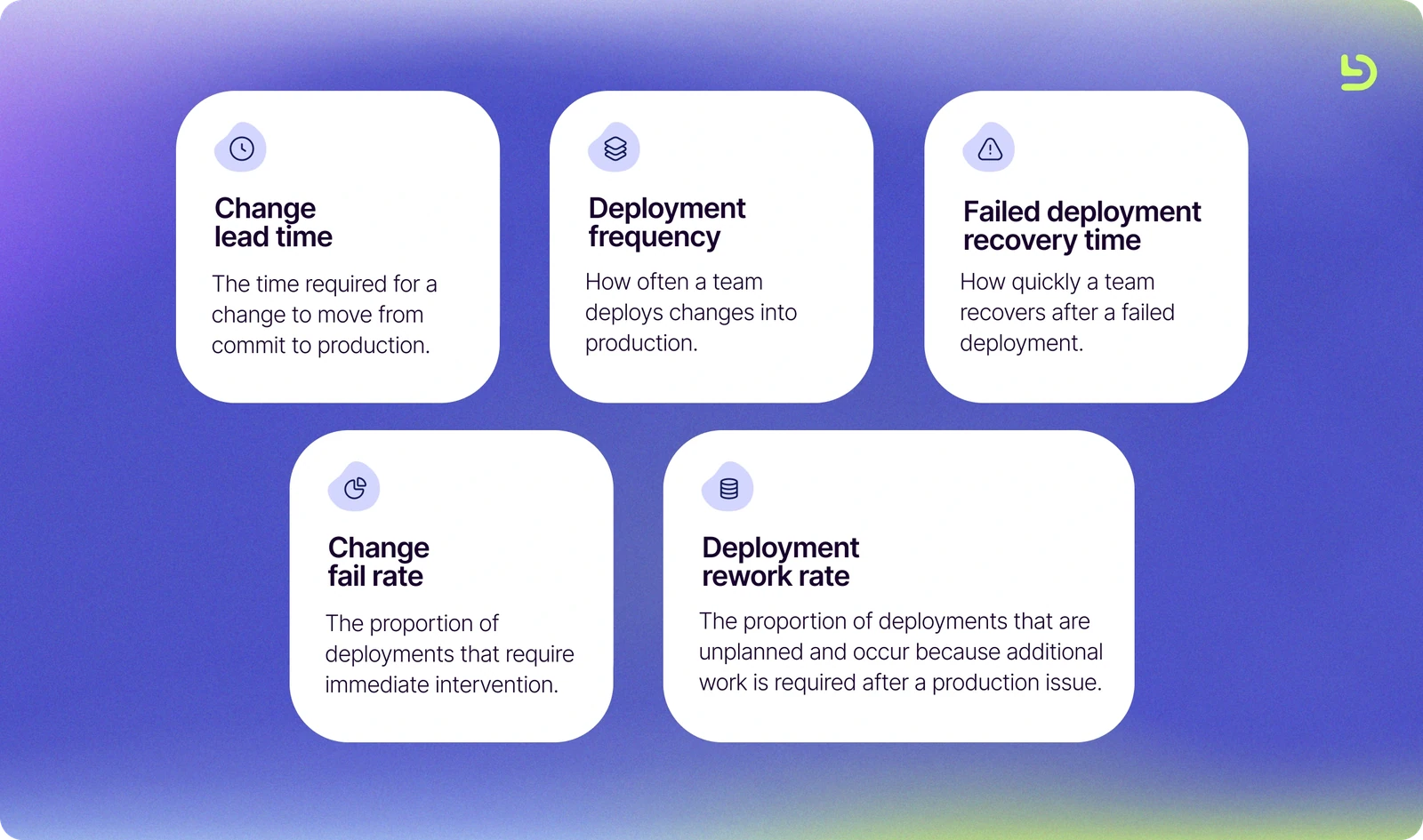
These indicators provide useful information about delivery performance, but they become more valuable when engineering leaders also understand how developers experience the processes behind those numbers.
Developer experience metrics
When looking specifically at developer experience metrics, the DevEx framework focuses on three dimensions: feedback loops, cognitive load, and flow state.
Feedback loops help teams understand how quickly developers receive useful information from testing, code reviews, CI/CD pipelines, deployments, and other parts of the engineering process.
Cognitive load looks at how much complexity a developer needs to manage while completing a task. High cognitive load may come from a complicated architecture, unclear ownership, fragmented documentation, or difficult operational processes.
Flow state focuses on the ability to make sustained progress without unnecessary interruptions or blockers. This includes the way meetings, communication, tooling, and dependencies affect a developer's ability to concentrate.
Regular surveys, retrospectives, interviews, and team conversations can complement operational data and provide a fuller view of the engineering experience.In my experience, some of the most useful questions are also very simple:
- Where do you lose the most time?
- Which tasks involve unnecessary manual work?
- What information do you regularly need to ask someone else for?
- Which part of shipping software feels harder than it should?
Those answers often point directly to opportunities to improve developer experience.
Building a stronger employee experience framework for engineering
A useful employee experience framework for engineering teams should connect delivery performance with the conditions developers encounter while trying to do their work. This means looking at technical systems, processes, communication practices, ownership, documentation, team dependencies, and business alignment together. Improvements in one area often affect several others because the engineering environment is highly interconnected.
One thing I have learned from working across different engineering organizations is that DevEx problems can become normalized very quickly. Teams adjust to slow pipelines, unclear handoffs, recurring interruptions, or difficult internal processes until those conditions start to feel like an unavoidable part of the job. That is why engineering leaders need to keep looking for friction even when the team has already learned how to work around it.
A faster pipeline, a documented architectural decision, clearer ownership, better requirements, or a simpler environment can each give developers more time and attention to focus on the technical problems that require their expertise.
For engineering leaders trying to decide where to begin, I usually come back to one question: What made it harder for your developers to ship software this week? The answer can provide a very practical starting point for measuring employee experience and deciding what to improve next.
Build engineering teams that can focus on delivery
At Devlane, we work closely with technology companies and engineering teams across different technical environments, processes, and stages of growth. That exposure has reinforced something I see repeatedly in my own role: talented developers perform better when they have strong technical context, clear ownership, reliable processes, and an environment that allows them to make progress.
For companies looking to improve employee experience within engineering, Developer Experience is an important place to look because many of the issues that affect daily work also affect collaboration, delivery, and team performance.
If you are looking to strengthen your engineering capacity while maintaining strong collaboration and technical alignment, talk to our team.


Other Blog Posts
.webp)
How to Build an AI Agent for Production