Nearshore software development in LATAM: The strategic advantages beyond cost

For years, nearshore software development in Latin America was primarily associated with cost reduction. Companies looked to the region as a way to lower engineering expenses while maintaining access to qualified talent. Today, that conversation looks very different.
Hiring experienced engineers has become increasingly challenging, particularly in specialized areas such as AI, cloud infrastructure, cybersecurity, and data engineering. At the same time, engineering leaders are under pressure to ship faster, scale teams more efficiently, and maintain product quality in an increasingly competitive market.
As a result, companies are no longer evaluating nearshore solely through the lens of cost savings. They're asking different questions:
- How quickly can we find the right talent?
- How well will those engineers integrate with our existing teams?
- How can we continue scaling without slowing down product development?
For many organizations, Latin America has emerged as one of the most attractive answers to those challenges. And while cost efficiency remains a benefit, the real value of nearshore software development today extends far beyond budget considerations.
What is nearshore software development?
Nearshore software development refers to working with engineering talent located in nearby countries that share similar time zones and business hours.
For US companies, Latin America has become one of the most attractive nearshore destinations. The region combines a large and growing pool of experienced software engineers with strong technical education systems, mature technology ecosystems, and increasing English proficiency.
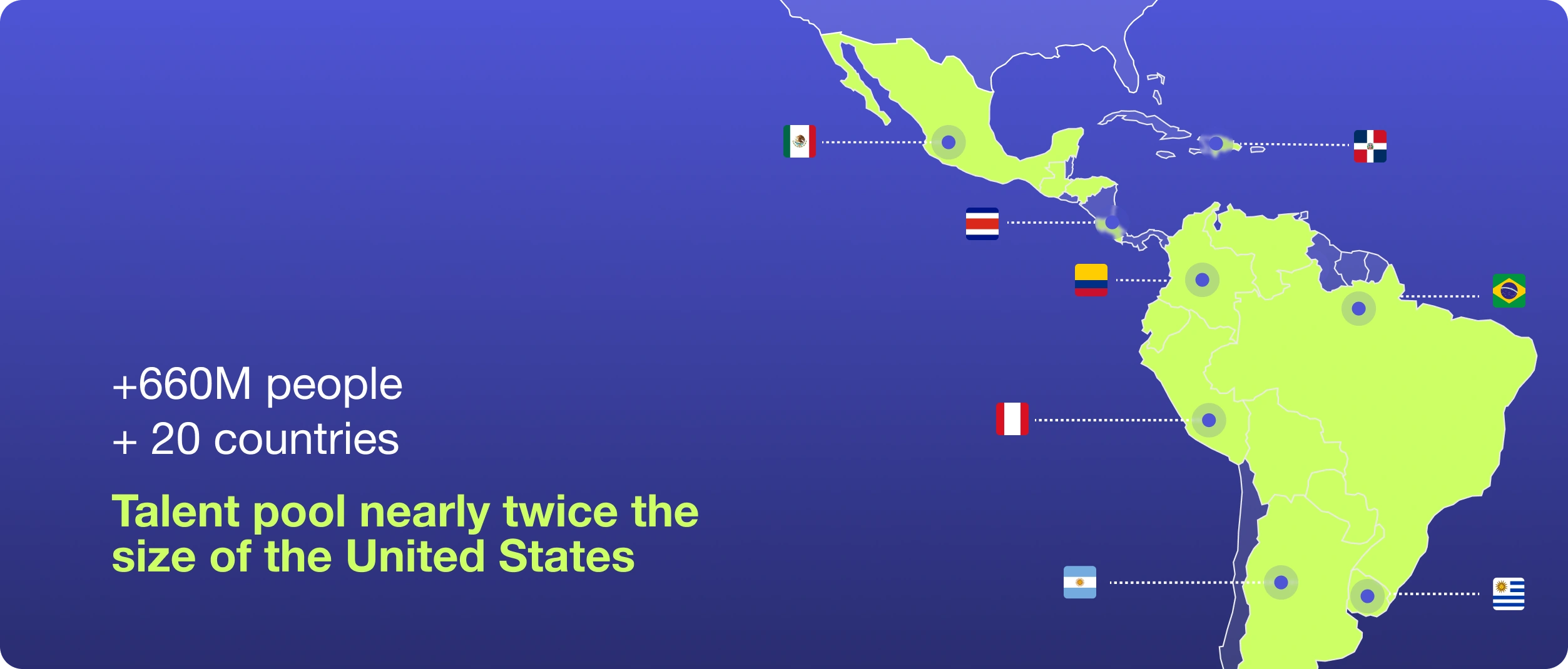
Today, companies can access expertise across every engineering discipline, from backend and frontend development to cloud infrastructure, data engineering, AI, machine learning, cybersecurity, and QA automation. Countries such as Uruguay, Argentina, Brazil, Colombia, and Mexico have developed thriving tech communities that continue to attract global investment and produce highly skilled talent.
At Devlane, for example, we hire and support engineers across more than 15 countries throughout Latin America, giving clients access to a broad and highly specialized talent pool.
Beyond talent access, one of the key advantages of nearshore software development is proximity. Unlike traditional offshore models, nearshore teams typically provide 4–6 hours of overlap with US business hours, enabling real-time collaboration, faster feedback loops, and more seamless integration with existing product and engineering teams.
Access to a growing pool of senior engineering talent
One of the biggest challenges facing technology companies today is not budget. It's access to talent.
Hiring senior engineers in the United States has become increasingly competitive, particularly for specialized roles in areas such as AI, cloud infrastructure, DevOps, data engineering, and cybersecurity. Even companies with strong hiring budgets often find themselves competing for a limited pool of experienced candidates.
At the same time, Latin America's engineering ecosystem has matured significantly. The region is now home to more than 2.8 million software developers, a number that has grown rapidly over the past decade thanks to strong universities, coding bootcamps, and a new generation of engineers building products for global markets.
Countries such as Uruguay, Argentina, Brazil, Colombia, and Mexico have developed thriving technology ecosystems that consistently produce highly qualified engineering talent. Many engineers already have experience working with US and international product teams, communicate fluently in English, and are familiar with the tools, workflows, and development practices used by modern technology organizations.
English proficiency has also become a major advantage across the region. According to the EF English Proficiency Index 2025, Argentina, Honduras, and Uruguay rank among the strongest countries in Latin America for English proficiency. In practice, this means standups, code reviews, technical documentation, architecture discussions, and stakeholder meetings can happen naturally in English without creating communication barriers.
For engineering leaders under pressure to scale, nearshore provides access to a broader and increasingly sophisticated talent market without compromising on quality. Rather than competing for the same limited pool of local candidates, companies can tap into a region that has become one of the world's fastest-growing hubs for engineering talent.
Real-time collaboration matters more than companies realize
Talent is important, but collaboration is what ultimately determines whether a distributed team succeeds. One of the biggest limitations of traditional offshore outsourcing models has always been the lack of overlap between teams. When engineers work eight to twelve hours apart, communication becomes slower, feedback loops stretch across days, and simple decisions can create unexpected delays.
Nearshore teams operate differently because Latin America shares similar business hours with the United States, engineering teams typically benefit from 4-6 hours of real-time collaboration every day. That overlap creates meaningful advantages:
- Faster decisions and problem solving
- More effective sprint planning and standups
- Better collaboration between engineering, product, and design
- Quicker feedback on pull requests and technical decisions
- Stronger team alignment overall
While time zone overlap may seem like a small operational detail, it often becomes one of the most important factors in helping distributed teams move faster and work more effectively together.
Engineers who are part of the team
A few years ago, companies often treated external teams as separate delivery organizations. Requirements were handed off, work was completed, and results were delivered back to the client.
The highest-performing nearshore teams operate very differently today. Rather than functioning as a separate vendor, engineers integrate directly into existing teams. They participate in sprint planning, contribute to architecture discussions, join standups, collaborate with stakeholders, and take ownership of product outcomes.
In many cases, the distinction between internal and external teams becomes almost invisible. That level of integration changes the outcome significantly. Engineers develop product context faster, contribute beyond individual tickets, and become active participants in technical decision-making.
For engineering leaders, this matters because scaling successfully isn't just about adding capacity. It's about adding people who can think critically, and solve problems independently. The strongest nearshore partnerships are built around that level of ownership and collaboration.
Why cost efficiency still matters
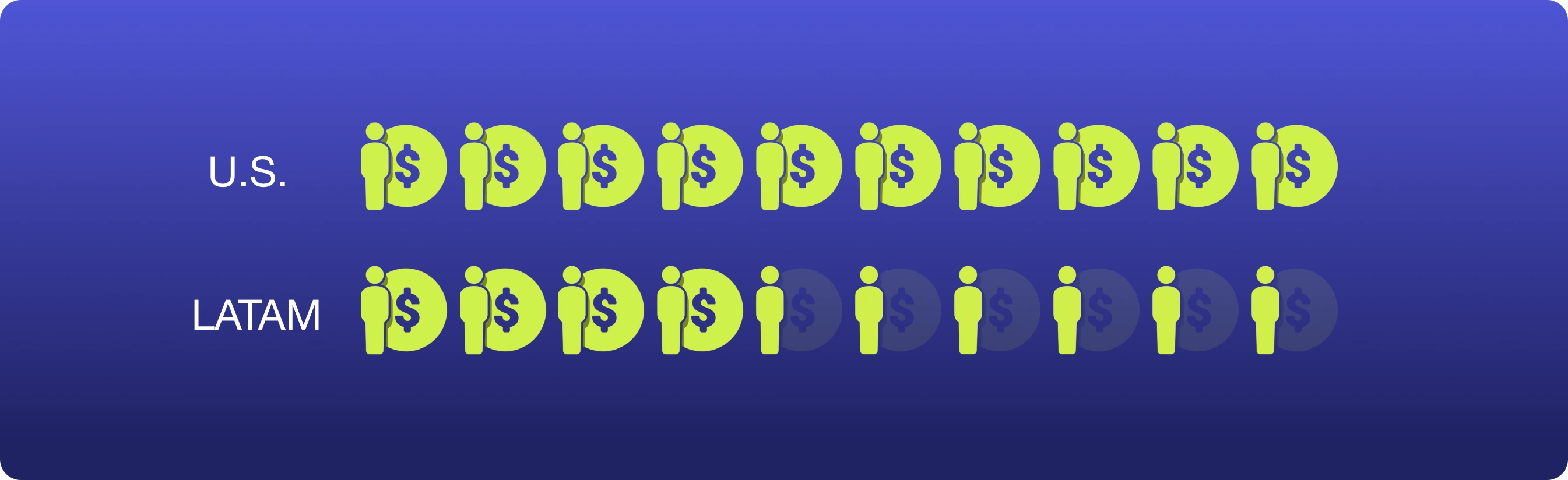
While the conversation around nearshore has evolved, cost remains an important part of the equation. A senior software engineer in the United States can easily cost between $150,000 and $200,000 per year in salary alone. Once benefits, taxes, recruiting expenses, equipment, and other overhead are factored in, the total investment becomes significantly higher.
In Latin America, companies can often access engineers with similar levels of experience and technical expertise at a substantially lower cost. Depending on the role, seniority, and location, organizations typically see savings of 40% to 60% compared to equivalent US hires.
For growing engineering organizations, those savings can have a meaningful impact. A team of 10 engineers can represent hundreds of thousands of dollars in annual cost efficiencies, capital that can be reinvested into product development, new initiatives, additional headcount, or strategic business priorities.
The companies seeing the greatest value from nearshore, however, are not simply spending less. They are using those efficiencies to scale faster. Cost savings may be what initially attracts organizations to LATAM, but the long-term advantage comes from what those savings enable: larger teams, faster hiring, access to specialized expertise, and greater capacity to execute ambitious product roadmaps.
Specialization is driving new demand
Another reason nearshore continues to gain momentum is the growing demand for specialized expertise. Organizations are investing heavily in artificial intelligence, cloud modernization, data platforms, automation, cybersecurity, and digital transformation initiatives. These projects require highly specialized engineers who can contribute immediately.
Building those capabilities internally often takes months. In many cases, hiring managers spend more time searching for the right talent than actually executing the project.
Nearshore partners with established talent networks can help bridge that gap by providing access to experienced professionals who already possess the skills required for complex technical initiatives. For many companies, this ability to access specialized expertise quickly has become one of the most compelling reasons to explore nearshore development.
This shift is reflected across the industry. Everest Group projects continued growth in outsourcing to Latin America through 2026, fueled largely by demand for specialized technical capabilities rather than cost savings alone. The region is no longer viewed simply as a source of affordable talent, but as a destination for companies seeking expertise that is increasingly difficult to find in their local markets.
Security and compliance have become non-negotiable
Engineering teams today often have access to source code, cloud environments, internal systems, customer information, and other business-critical assets. As a result, organizations need more than technical talent. They need confidence that security standards will be maintained across every stage of the engagement.
This is where operational maturity becomes just as important as recruiting capability. At Devlane, security is treated as a core operational function. Our security program is led by a dedicated Chief Information Security Officer (CISO) and supported by processes designed to meet client-specific security requirements.
Depending on the engagement, this may include secure device procurement and provisioning, endpoint protection, mobile device management (MDM), VPN and access control requirements, secure hardware configurations, and alignment with internal security frameworks.
This becomes especially important for organizations handling sensitive data or operating in regulated industries such as healthcare, fintech, and other compliance-driven sectors. These practices help ensure engineers can integrate smoothly into existing environments while meeting established security requirements.

Final thoughts
We can confidently say the question is no longer whether nearshore works. Thousands of companies, from startups to global enterprises, have already proven that it does. The more relevant question today is what role nearshore should play in your engineering strategy.
That answer will look different for every organization. A startup may be looking for a way to extend its capacity without slowing product development. A growing scale-up may need access to specialized expertise. An enterprise may be searching for a more scalable approach to expanding engineering capacity across multiple teams.
What they all have in common is the need to move faster without compromising quality. And while every situation is different, understanding the potential impact on your team structure, hiring plans, and budget is often a good place to start. Our nearshore savings calculator can help model different scenarios and provide a clearer picture of what that could look like for your organization.
At Devlane, we've seen firsthand how the conversation around nearshore has evolved over the years. What was once primarily viewed as a cost-saving initiative has become a strategic way for companies to access talent, scale engineering teams, and support long-term growth.
Whether you're actively exploring nearshore software development or simply evaluating future hiring options, it's a model that is increasingly becoming part of how modern engineering organizations scale.


Other Blog Posts
.webp)
How to Build an AI Agent for Production