Forward deployed engineering isn’t new, but the role is gaining attention as more companies move from experimenting with AI to implementing it in their products and operations. These projects often involve complex integrations, legacy systems, security requirements, and business processes that demand hands-on engineering expertise and close collaboration with the teams involved.
The growing demand is reflected in the hiring market. According to Indeed data reported by Business Insider, forward deployed engineer (FDE) job postings were roughly 729% higher in April 2026 than a year earlier. Companies including Amazon, EY, and Salesforce are also investing in the role, alongside Palantir and leading AI companies, as LeadDev reports.
But what exactly sets a forward deployed engineer apart from other engineering roles, and when does a company need one? Understanding how FDEs work, what they bring to a project, and how they compare with other engineering models can help companies make better decisions about the expertise they need.
Key insights
- Forward deployed engineers work directly with customers: They develop and deploy software within client environments, integrating technology with existing systems and business processes.
- AI adoption is driving demand: Companies increasingly need engineers who can integrate AI solutions into complex, real-world environments.
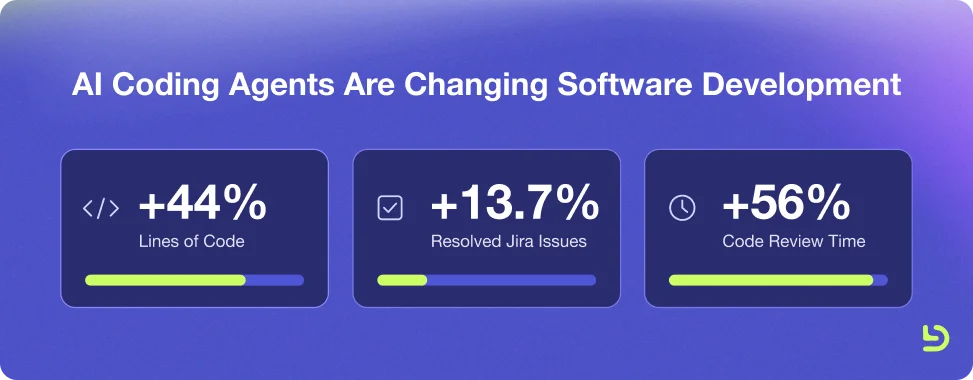
- More code doesn't always mean faster delivery: Research shows that AI coding agents increased code production by 44%, while completed work grew by just 13.7%.
- Different projects require different engineering models: FDEs, staff augmentation, and custom software development address different needs depending on the project's scope and technical requirements.
What is a forward deployed engineer?
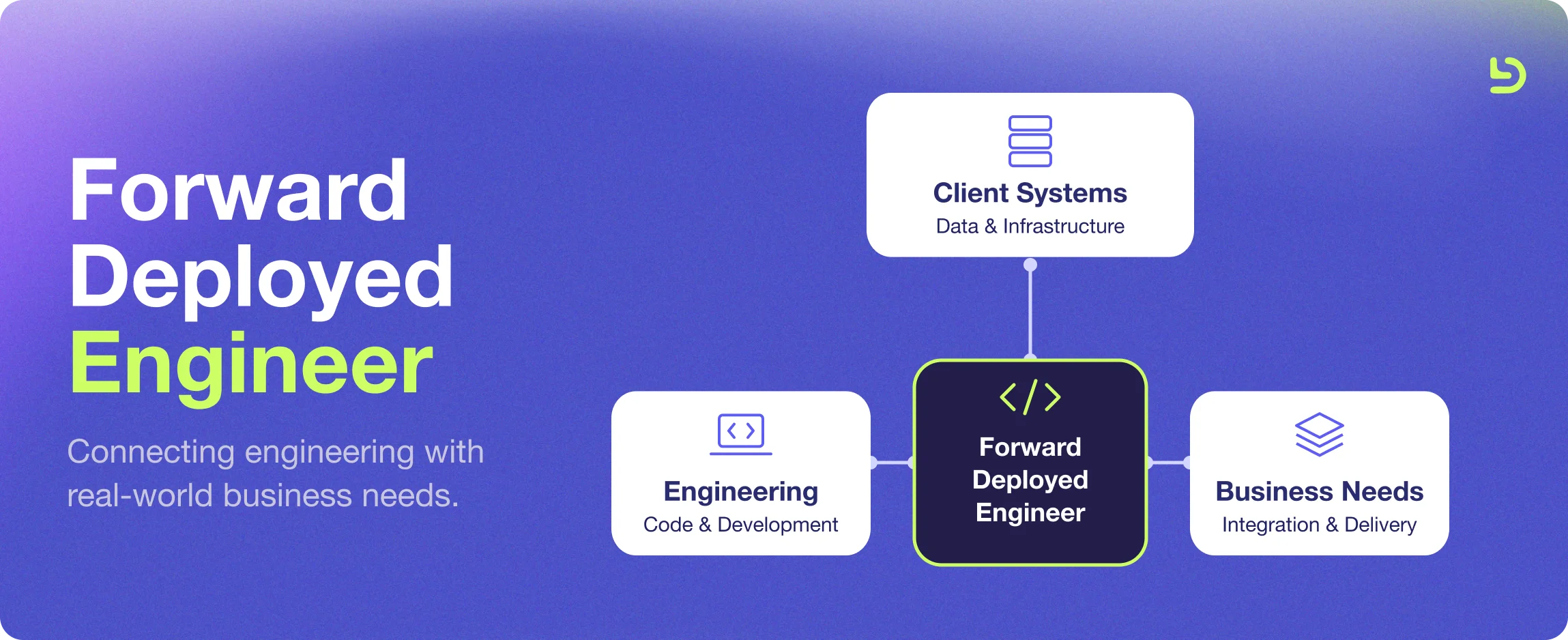
A forward deployed engineer (FDE) is a software engineer who works directly with a customer to build and deploy software within their systems. This can involve integrating new technologies, working with the customer’s data, or developing solutions for specific business needs. The role was popularized by Palantir, which embeds engineers with clients to solve technical challenges and bring solutions into production.
As Illinois Tech explains, Palantir describes the difference this way: a traditional product engineer typically works on one capability used by many customers, while an FDE works across different capabilities for a single customer.
However, companies don’t always use the title in the same way. An analysis of 1,000 FDE job postings by Bloomberry identified three categories: builder FDEs (60%), sales or solutions engineering roles (30%), and internal tools builders (10%). This article focuses on builder FDEs, whose work centers on developing and deploying production software for customers.
Forward deployed engineer vs. software engineer vs. solutions engineer
While these roles can overlap, they generally differ in what they build, how they work with customers, and how their work is evaluated.
Why forward deployed engineer demand is accelerating
Enterprise AI adoption is driving demand for forward deployed engineers, particularly as companies integrate new technologies with legacy systems, internal data, and existing workflows. At Devlane, we've seen a similar trend, with growing client demand for engineers who can navigate complex systems and work closely with business and technical teams. At the same time, AI coding agents are increasing the amount of code engineers produce without a comparable increase in completed software.
In Artificial Intelligence in the Firm: Bottlenecks in Software Production, Harvard economists Fiona Chen and James Stratton analyzed 445 million work events from 720,542 workers across 655 firms between January 2021 and August 2026, using data from Jellyfish. Their findings reveal a growing gap between coding activity and software delivery:
- Increased code production: After adopting AI coding agents, companies generated 44% more lines of code and approximately 36% more pull requests.
- Slower growth in completed work: Resolved Jira issues increased by 13.7%, with estimates ruling out an increase greater than 30.7%.
- Longer code reviews: Approval times increased by 56%, while comments per code change rose by 39%.
Reviewing that code requires familiarity with the system. According to the study, 82.8% of reviews involve code the reviewer already knows, while 75.7% of code written by senior engineers is reviewed by other senior engineers. These findings highlight why increasing code production doesn’t necessarily accelerate delivery. The study has not yet been peer reviewed.
Security presents similar challenges. Veracode’s October 2026 GenAI Code Security Report found that the security pass rate of AI-generated code improved from 56% to 62%. However, roughly four in ten coding tasks still produced vulnerable code without security-specific guidance.
Together, these findings help explain why companies increasingly value engineers who understand their systems and can manage the complexities of bringing software into production. Forward deployed engineers bring that expertise directly into the customer’s environment, working alongside internal teams to integrate new technologies and address technical challenges.
When does a company need a forward deployed engineer?
Companies typically consider forward deployed engineers when a project requires close collaboration with internal teams and hands-on work within their existing systems. Some common situations include:
- Moving AI projects into production: A working prototype still needs to integrate with internal data, permissions, and business workflows.
- Working with complex systems: Legacy infrastructure, regulated data, and on-premise environments often require extensive integration and customization.
- Defining technical requirements: When project requirements are unclear, FDEs work directly with business and technical teams to understand the challenges and develop appropriate solutions.
- Implementing enterprise platforms: Software vendors often provide FDEs to help customers integrate and deploy their technology within existing environments.
When the main challenge is expanding engineering capacity or delivering a well-defined project, staff augmentation or custom software development may be a better fit, depending on the company’s needs.
Key skills for forward deployed engineers
Forward deployed engineers need a combination of technical expertise, problem-solving skills, and the ability to work closely with customers. The most common requirements include:
- Full-stack development: FDEs work across different technologies and systems, from data pipelines and APIs to front-end applications. Python appears in 66% of FDE job postings, while TypeScript is mentioned in 35%.
- AI integration: Experience with AI technologies is increasingly relevant, with AI agents mentioned in 35% of postings and LLMs in 31%. This includes understanding how to integrate AI into existing systems and when agentic AI makes sense for software development projects.
- Code review and AI fluency: FDEs need to evaluate code quality, identify potential issues, and review AI-generated code before deployment. These skills are increasingly important as AI becomes part of everyday development workflows.
- Security and data governance: Working within customer environments requires familiarity with security protocols, access controls, and compliance requirements, particularly when handling sensitive data across distributed engineering teams.
- Problem-solving and communication: FDEs work directly with technical and business teams to define requirements, address challenges, and translate business needs into technical solutions.
Most FDE positions require previous engineering experience, with 60% of postings that specify experience asking for three to five years and only 12% targeting entry-level candidates.
Choosing the right engineering model
Companies can approach complex engineering projects in different ways, depending on their technical requirements, internal resources, and the level of support they need.
- Hiring FDEs in-house: Companies that regularly deploy technology for customers may benefit from building their own forward deployed engineering teams.
- Working with a vendor’s FDEs: When implementing a complex software platform, vendors may provide engineers who specialize in integrating their technology into the customer’s environment.
- Staff augmentation: Companies can bring senior engineers into their existing teams to contribute to ongoing projects, work within established processes, and provide additional technical expertise.
- Custom software development: For projects that require end-to-end delivery, a technology partner can take responsibility for designing, developing, and implementing a complete solution.
Where Devlane fits
At Devlane, we help U.S. companies build and scale software through IT staff augmentation and custom software development. Through staff augmentation, our senior Latin American engineers integrate into existing teams, working with their tools, processes, and technical requirements. For companies looking to develop a new product or tackle a complex software project, our custom development teams manage delivery from discovery through launch.
Both approaches combine senior engineering expertise, AI-enabled development, and security practices backed by our ISO 27001:2022 certification. Our success stories show how we apply these capabilities across different industries and technical challenges.
Final thoughts
The growing demand for forward deployed engineers reflects how important hands-on technical expertise has become as companies integrate AI and other technologies into their operations. Understanding when this role makes sense, and when other engineering models may be a better fit, can help companies make more informed decisions about their projects.
If you’re planning a new software project or looking to strengthen your engineering team, let’s talk about how we can help.

Frequently Asked Questions
Are forward deployed engineers only needed for AI projects?
No. While AI adoption has increased demand for FDEs, the role is also relevant for complex software implementations, legacy system integrations, and projects that require extensive customization within a customer's environment.
What's the difference between a forward deployed engineer and a solutions engineer?
Solutions engineers typically help customers evaluate and understand a product, often through demonstrations and proofs of concept. Forward deployed engineers focus on implementing solutions, writing production code, and integrating technology into the customer's existing systems.
Can forward deployed engineers work remotely?
Yes. Although some positions require on-site collaboration or travel, FDEs can also work remotely. What matters is their ability to collaborate closely with customer teams and access the systems, tools, and resources needed for implementation.
How does hiring an FDE differ from working with a technology partner?
An FDE is an engineering role, while a technology partnership defines how a company accesses engineering expertise. Staff augmentation allows companies to add engineers to existing teams, while custom software development provides a dedicated team responsible for delivering a complete solution. The right approach depends on the project's requirements and the level of support needed.
What is the difference between an FDE and an FDSE?
Both terms generally refer to the same role. FDSE stands for Forward Deployed Software Engineer, the title popularized by Palantir, while FDE is the shorter term commonly used across the industry.

Other Blog Posts
Forward Deployed Engineer: What the Role Is and Why AI Is Driving Demand

What agentic AI means, and how to introduce it into your software development projects