Best Generative AI Tools in 2026: The Complete Guide
A few years ago, generative AI was still a cool experiment, something teams tried out on the side. Today it's just part of how business runs. What started with chatbots and basic content tools has turned into a huge ecosystem of platforms that write code, create videos, do research, automate workflows, generate images, and who knows what else.
That shift has changed the conversations we're having with the companies we work with. Almost nobody asks us anymore whether AI is worth exploring, that question is settled. What they actually want to know is which tools deserve a real spot in their stack, and how those tools fit into the workflows they already have.
And that part has gotten harder, not easier. The market is more crowded than ever. New AI products show up every week, the platforms already out there keep adding new features, and the lines between categories keep getting blurrier. At this point, picking the right tool matters almost as much as deciding to use AI in the first place.
So that's what this guide is for, breaking down the best generative AI tools out there in 2026. Organized by category, with an honest look at where each one actually shines, plus what we think teams should weigh before committing to any of them.
Key Takeaways
- The best generative AI tool isn't the most advanced one but the one that fits naturally into your team's workflows and delivers measurable value.
- ChatGPT, Claude, Gemini, Cursor, Perplexity, and Runway remain among the most impactful AI tools across business, engineering, research, and creative teams in 2026.
- AI adoption is moving beyond individual productivity and toward workflow automation, knowledge management, and AI-assisted decision-making.
- Organizations are increasingly building AI-powered systems and processes rather than relying on standalone tools.
- Access to AI tools is becoming universal, execution is what creates an advantage.
What are generative AI tools, anyway?
Generative AI tools are applications powered by AI models that can create new content based on what you give them. But what does that actually mean in practice? Here's the simple way to think about it: unlike traditional software, which just follows the rules someone programmed into it, these systems can generate text, code, images, video, audio, and even full business analyses on their own.
And the category has grown a lot in the past couple of years. Early on, it was mostly writing assistants. Now it covers coding copilots, AI-native search engines, video generators, research assistants, workflow automation platforms, and enterprise knowledge systems. Basically, if you can describe a task in words, there's probably a tool out there trying to do it for you.
For a lot of organizations, generative AI is becoming less of a "thing we use sometimes" and more of a layer that sits across every department, quietly helping teams work faster and make better calls.
What makes a great Generative AI tool in 2026?
With hundreds of AI products now competing for attention, evaluating them has become more complicated than simply comparing features or model benchmarks. The reality is that most organizations don't need the most advanced AI tool. They need the one that fits naturally into how their teams already work. The platforms creating the most value today tend to share a few characteristics:
- They integrate seamlessly into existing workflows. The best tools don't force teams to reinvent their processes. They fit into the systems, and routines people already use every day.
- They understand context. Whether it's your codebase, internal documentation, business processes, or company knowledge, context-aware AI consistently produces more useful and reliable results than tools operating in isolation.
- They meet enterprise requirements. Security, governance, reliability, compliance, and integrations have become critical evaluation criteria, especially as AI moves from experimentation into production environments.
- They create measurable impact. The most successful AI implementations aren't necessarily tied to the most powerful models. They're tied to outcomes: faster development cycles, improved productivity, reduced operational overhead, or better decision-making.
Ultimately, the best generative AI tool isn't the one with the most impressive demo. It's the one your team will actually use, trust, and benefit from over the long term.
The best Generative AI tools in 2026
AI assistants and productivity tools
This is the category most people think about when they hear "generative AI." These platforms can help users write content, summarize documents, analyze data, brainstorm ideas, and answer questions. For many organizations, they serve as the foundation of their AI strategy.
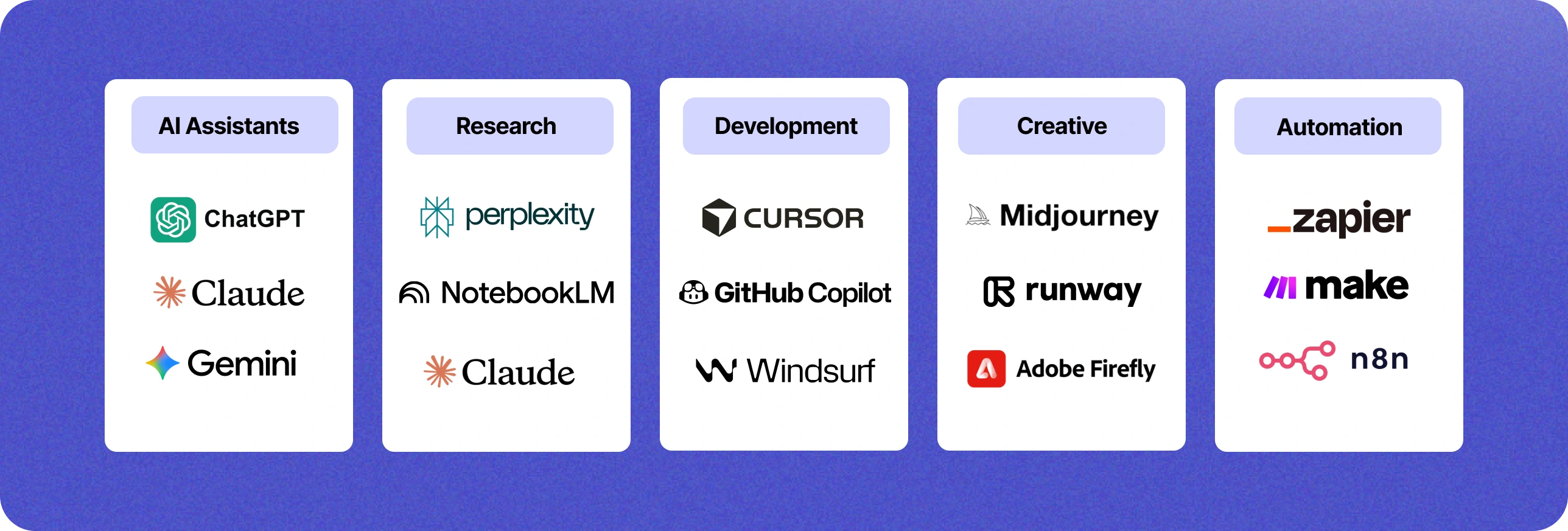
- Claude: Strong reasoning and a real talent for working with large volumes of information. We see it land especially well with writers, analysts, and leadership teams who need to think through something dense, not just generate a quick draft.
- ChatGPT: The generalist. Writing, coding, research, analysis, light automation. It does a credible job at almost everything, which is exactly why so many teams work with it.
- Gemini: Google's flagship, baked directly into Gmail, Docs, Sheets, and the rest of Workspace. If your team already lives there, the integration alone is worth a look.
- Microsoft Copilot: The natural fit for Microsoft 365 shops, putting AI directly inside Outlook, Excel, Teams, and Word instead of asking people to leave their tools to use it.
AI tools for research and search
One of the biggest shifts in 2026 is the way people find information. AI-powered research tools are replacing traditional search workflows by delivering summarized answers with context and citations.
- Perplexity: Probably the strongest AI-native search engine right now. Source-backed answers make it genuinely useful for market research, competitive analysis, and technical digging. Its Comet browser has also turned it into something closer to a full research workspace than a search box.
- ChatGPT Deep Research: Built for multi-step research, where you need something to chase down threads and synthesize them into an actual report.
- Gemini Deep Research: Plays especially well if you're already deep in the Google ecosystem.
- NotebookLM: Worth a special mention: feed it your own documents and it becomes a research assistant scoped entirely to your material, with surprisingly good audio summaries if you'd rather listen than read.
- Glean: Instead of searching the web, Glean connects to your company's internal systems: documents, tickets, chats, wikis, code repositories, and more, making it easier for employees to find information and get answers from organizational knowledge.
AI tools for software development
Few industries have adopted generative AI as rapidly as software engineering. Today's coding assistants can generate code, review pull requests, explain legacy systems, and even complete complex development tasks autonomously.
- Cursor: As close to an AI-native IDE as it gets right now. It understands entire repositories well enough to act less like a tool and more like a genuine engineering collaborator.
- GitHub Copilot: The original, and still a favorite for a reason: it's deeply embedded in the IDEs developers already use every day.
- Windsurf: A fast-growing option built around agentic, multi-step development workflows rather than single-line suggestions.
- Lovable, v0, and Bolt.new: Worth mentioning together, this newer wave goes beyond autocomplete and generates entire working apps: frontend, backend, and database. Lovable in particular has grown faster than almost anything else in this space, which says a lot about where the demand is heading.
- Claude Code: Anthropic's coding agent brings Claude directly into the development workflow, allowing engineers to work across large codebases, execute multi-step tasks, and interact with projects through natural language. It's quickly becoming a favorite for teams tackling complex engineering work.
AI image generation and editing tools
AI image generation has evolved from novelty to a legitimate creative workflow used by marketers, designers, startups, and enterprises.
- Midjourney: Still the gold standard for striking, artistic imagery and early-stage creative concepts.
- Adobe Firefly: A solid pick for commercial teams, thanks to licensing protections and tight Adobe ecosystem integration.
- Ideogram: Particularly strong when you actually need legible text inside the image, think ads and social graphics.
- Adobe Photoshop (Generative Fill): Still quietly reshaping how professional image editing gets done.
- Canva AI: The accessible option for teams without a dedicated designer on hand.
AI video generation tools
Video is one of the fastest-moving corners of generative AI right now, and the gap between "AI video" and "video" is closing fast.
- Runway: One of the most advanced platforms out there for generating and editing high-quality video.
- Veo: Google's video model, continuing to push realism and motion consistency forward.
- Synthesia: The go-to for training videos, onboarding content, and corporate communications that need to look polished without a production budget.
- HeyGen: Worth keeping an eye on for AI avatars specifically, useful for localized training content and sales outreach at scale.
AI audio and voice generation tools
AI-generated audio is becoming increasingly common in podcasts, marketing, customer support, and content production.
- ElevenLabs: Widely considered the leader in realistic AI voice generation.
- Descript: Combines audio editing, transcription, and AI voice generation in one place, which makes it a favorite for lean content teams.
- Canva AI: Once again stands out for its ease of use, offering built-in AI features that allow users to generate voiceovers with customizable options such as region, age, accent, and tone, all directly within the platform.
AI automation and agent platforms
This may be one of the most underrated AI categories for businesses in 2026. Unlike traditional generative AI tools that focus on creating content, these platforms are designed to orchestrate actions across systems, automate workflows, and eliminate repetitive manual work. In many cases, that operational efficiency becomes an even bigger advantage than content generation itself.
What's interesting is that while these tools increasingly incorporate generative AI capabilities, they're often overlooked in conversations about AI adoption. Yet for many organizations, they deliver some of the most tangible returns by saving teams significant time, reducing operational overhead, and allowing employees to focus on higher-value work.
- Zapier AI: Connects thousands of apps and lets teams build AI-powered workflows without writing a line of code.
- Make: More visual, more advanced, built for teams that need sophisticated, branching processes.
- n8n: The pick for technical teams that want more control and customization under the hood.
How to actually implement AI on your team
Choosing AI tools is the easy part. Getting a team to adopt them in a way that creates lasting value is where most organizations struggle. The companies seeing meaningful results tend to approach implementation with the same discipline they apply to any other technology investment.
- Start with a specific problem, not a company-wide initiative. Teams that try to "roll out AI" across the entire organization often end up with low adoption and a growing list of unused subscriptions. The most successful implementations usually begin by solving a single, well-defined pain point. Small wins create momentum.
- Establish guardrails before scaling usage. As AI becomes more deeply integrated into engineering workflows, questions around security, data access, compliance, and review processes become increasingly important. This is especially true as coding assistants and AI agents gain the ability to take action across repositories, infrastructure, and business systems.
- Treat AI literacy as a core skill. The teams moving fastest aren't always using the most sophisticated tools. More often, they're simply better at leveraging the tools they already have. Effective prompting, workflow design, evaluation, and AI-assisted problem-solving are becoming valuable skills across engineering, product, and business functions alike.
- Reassess your stack regularly. AI evolves on a quarterly cadence, not a multi-year one. A platform that feels best-in-class today may face entirely new competition within a few months. Organizations that build regular evaluation cycles into their technology strategy are better positioned to adapt as the landscape changes.
- Don't mistake adoption for strategy. Deploying AI tools is not the same as having an AI strategy. The companies generating the strongest returns have a clear understanding of where AI creates value, what outcomes they're trying to improve, and how they'll measure success over time.
Where the real advantage comes from: AI Execution
The AI landscape has matured rapidly. Access to powerful models, copilots, agents, and automation platforms is no longer limited to a handful of companies. Today, almost every organization can experiment with the same technologies. What increasingly separates market leaders from everyone else is execution.
The challenge is no longer finding AI tools. It's identifying the right opportunities, integrating those tools into existing workflows, and helping teams adopt them in a way that drives measurable results. That requires technical expertise, operational discipline, and the ability to keep shipping while the technology continues to evolve.
The organizations gaining the most value from AI aren't treating it as a standalone initiative. They're embedding it into how products are built, and and how work gets done across the business. As AI becomes a standard part of the technology stack, the question is no longer whether companies should adopt it. The question is how quickly they can turn experimentation into execution, and execution into a lasting competitive advantage.
At Devlane, we work with companies navigating exactly that challenge. By connecting U.S. organizations with senior nearshore engineers across Latin America, we help teams expand their capacity, and accelerate adoption of new technologies without losing focus on their core roadmap.
FAQS
What is the best generative AI tool in 2026?
There is no single best tool for every use case. The most widely adopted options include ChatGPT, Claude, Gemini, Cursor, Perplexity, and Runway, each serving different needs across business, engineering, research, and creative work.
What is agentic AI?
Agentic AI refers to systems that can plan, reason, and execute multi-step tasks with limited human intervention. Many modern AI coding assistants, research tools, and automation platforms are beginning to incorporate agentic capabilities.
What is the best AI tool for software development?
The best option depends on the workflow. Cursor, Claude Code, GitHub Copilot, and Windsurf are among the most popular tools for code generation, repository understanding, and AI-assisted development.
What is the best AI tool for research?
Research-focused tools such as Perplexity, NotebookLM, Glean, ChatGPT Deep Research, and Gemini Deep Research help teams find information, analyze sources, and work more effectively with internal knowledge.
How do companies get the most value from AI?
Organizations that see the strongest results focus on solving specific business problems, integrating AI into existing workflows, and enabling teams to adopt the technology effectively.

Other Blog Posts
.webp)
How to Build an AI Agent for Production