.webp)
Over the last year, AI in healthcare stopped being a futuristic topic and became a very practical one. Industry reports and organizations like HIMSS have highlighted how AI is already being applied across clinical, operational, and patient-facing use cases. It’s no longer about whether artificial intelligence will be adopted, but about where it is actually creating value today, and just as importantly, where it still isn’t…
From conversations with founders, product leaders, and healthcare executives, one thing is clear: the real transformation is happening at the intersection of clinical decision-making, operational efficiency, and patient experience, and AI is becoming the common layer connecting all three.
In this article, we’ll walk through some of the most relevant technologies shaping healthcare today and, more importantly, what it takes to turn these trends into real, scalable systems.
Healthcare AI as a Decision Layer
When people talk about healthcare AI, they often jump straight to diagnostics. While that’s part of the picture, the most immediate impact I’m seeing is in decision support systems.
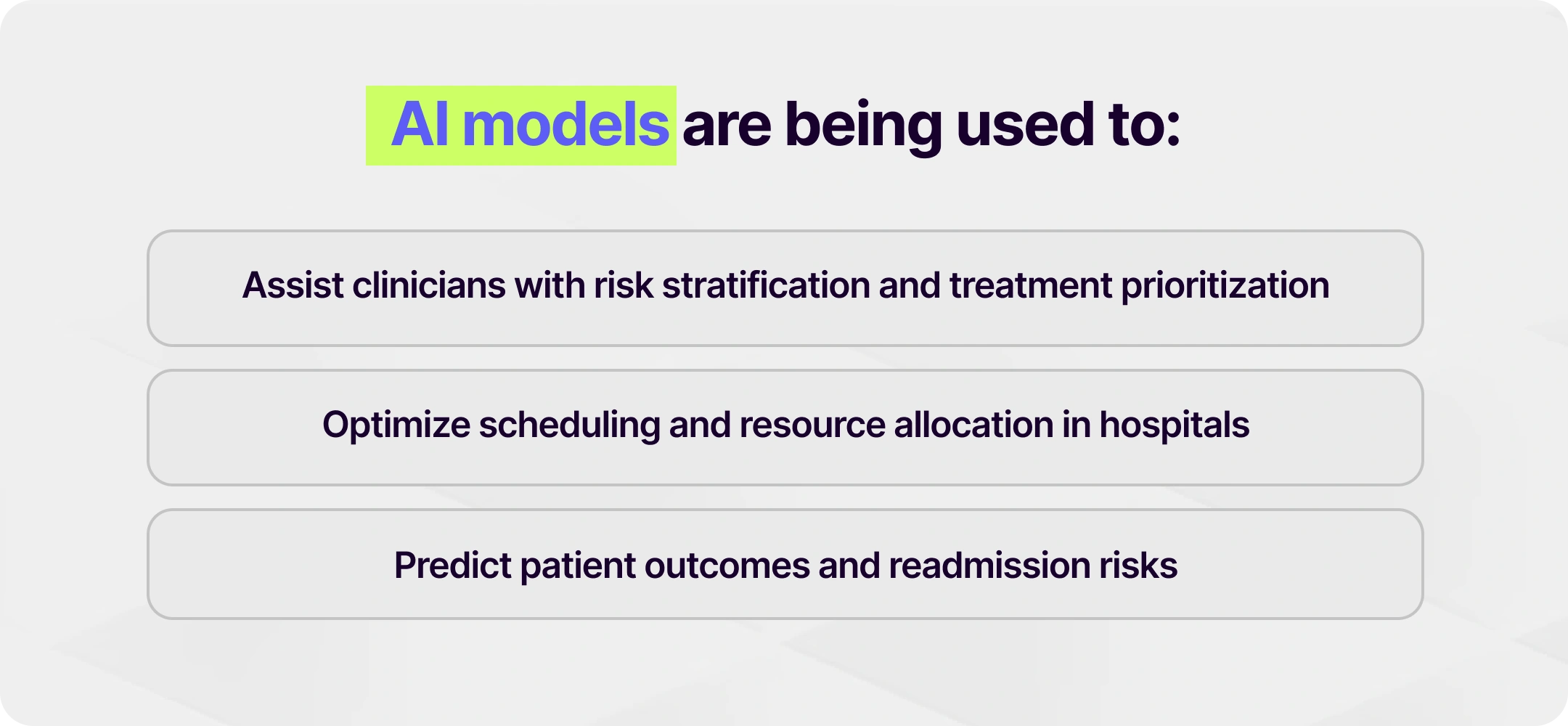
What’s interesting is that these systems are not replacing professionals, they’re augmenting judgment. In environments where healthcare teams are overloaded and time-constrained, AI helps reduce cognitive load and improve consistency. In that sense, AI is less about automation and more about enabling better decisions at scale.
This is where execution really matters. Decision-support systems only deliver value when they’re seamlessly integrated into existing products, workflows, and data pipelines, and built to meet the realities of regulated healthcare environments.
That’s where the right engineering talent makes the difference. By embedding senior, healthcare-experienced engineers directly into product and technology teams, AI initiatives can move beyond experimentation and into reliable, production-ready solutions.
At Devlane, we partner with companies across the healthcare industry, supporting teams in very different areas of expertise, from clinical platforms to specialized medical solutions. Organizations like Huckleberry, Linus Health, Aro Medical, and Riparian, among others, have relied on our engineers to move AI initiatives from concept to production and into real-world impact.
Digital Twins: Simulating Healthcare Before It Happens
One of the most promising emerging areas is digital twins. A digital twin in healthcare is a virtual replica of a physical object, it uses medical data to model a patient’s unique anatomy, supporting personalized care decisions. Originally popular in manufacturing and engineering, digital twins are now being applied to simulate:
- Patient journeys.
- Hospital workflows.
- Treatment scenarios.
By creating a virtual representation of real-world systems, teams can test strategies, predict outcomes, and optimize decisions before applying changes in real environments.
For example:
- Simulating patient flow to reduce ER wait times.
- Testing treatment plans on virtual patient models.
- Predicting the impact of policy changes on operational performance.
This shifts healthcare from a reactive model to a predictive and experimental one, where decisions can be validated digitally before affecting real people.
Robotic Process Automation: The Silent Productivity Multiplier
While AI gets most of the headlines, Robotic Process Automation (RPA) in healthcare is arguably delivering some of the most immediate ROI.
Healthcare is full of repetitive, rule-based processes: claims processing, billing and coding, patient onboarding and data migration between systems.
RPA allows organizations to automate these workflows without rewriting their entire infrastructure. The result is not just cost reduction, but faster cycles, fewer errors, and happier staff.
In many cases, RPA becomes the foundation layer on which more advanced AI systems are later built.
.webp)
Virtual Reality: Beyond the Hype
Virtual reality in healthcare tends to sound futuristic, but its most successful applications today are surprisingly practical:
- Training surgeons and medical staff in simulated environments.
- Pain management and mental health therapies.
Physical rehabilitation programs.
VR shines where experience matters more than theory. It creates safe spaces for learning and treatment, without real-world risk.
It’s not the core of digital healthcare transformation, but it’s becoming an important complementary tool, especially in education and therapy.
The Real Shift: At-Home and Remote Care
If there’s one area where future healthcare technology is clearly headed, it’s at-home care.
Aging populations, rising costs, and clinician shortages are forcing the system to evolve. AI-enabled remote care is becoming not just convenient, but necessary.
Key trends include:
- AI-driven patient monitoring.
- Predictive alerts for chronic conditions.
- Virtual consultations supported by decision systems.
- Smart devices collecting real-time health data.
The hospital is slowly losing its monopoly as the center of care. The future looks more like a distributed healthcare network, where technology acts as the connective tissue between patients, professionals, and systems.
Why Execution Matters in Healthcare AI
What’s striking today is that technology itself is rarely the limiting factor. Most healthcare teams already have clear ideas, access to data, and AI use cases that make sense. The harder part is actually building and scaling those ideas inside a real product.
One example is Huckleberry, one of our clients. Their app supports families with personalized, data-driven insights, which means the product has to balance thoughtful UX with increasingly complex data and AI-driven functionality behind the scenes.
As the product grew, the challenge wasn’t about what to build, but how to keep moving fast without breaking what already worked. Supporting that evolution required experienced engineers who could plug into the existing team, understand the product context quickly, and help scale new capabilities in a sustainable way. In practice, this meant adding +10 senior engineers, fully embedded into Huckleberry’s product and engineering workflows.
This kind of setup makes it possible to move from validated ideas to production features, without slowing down the roadmap or overloading internal teams. That’s why execution becomes the real differentiator.
Scaling AI solutions in healthcare usually comes down to a few very practical things:
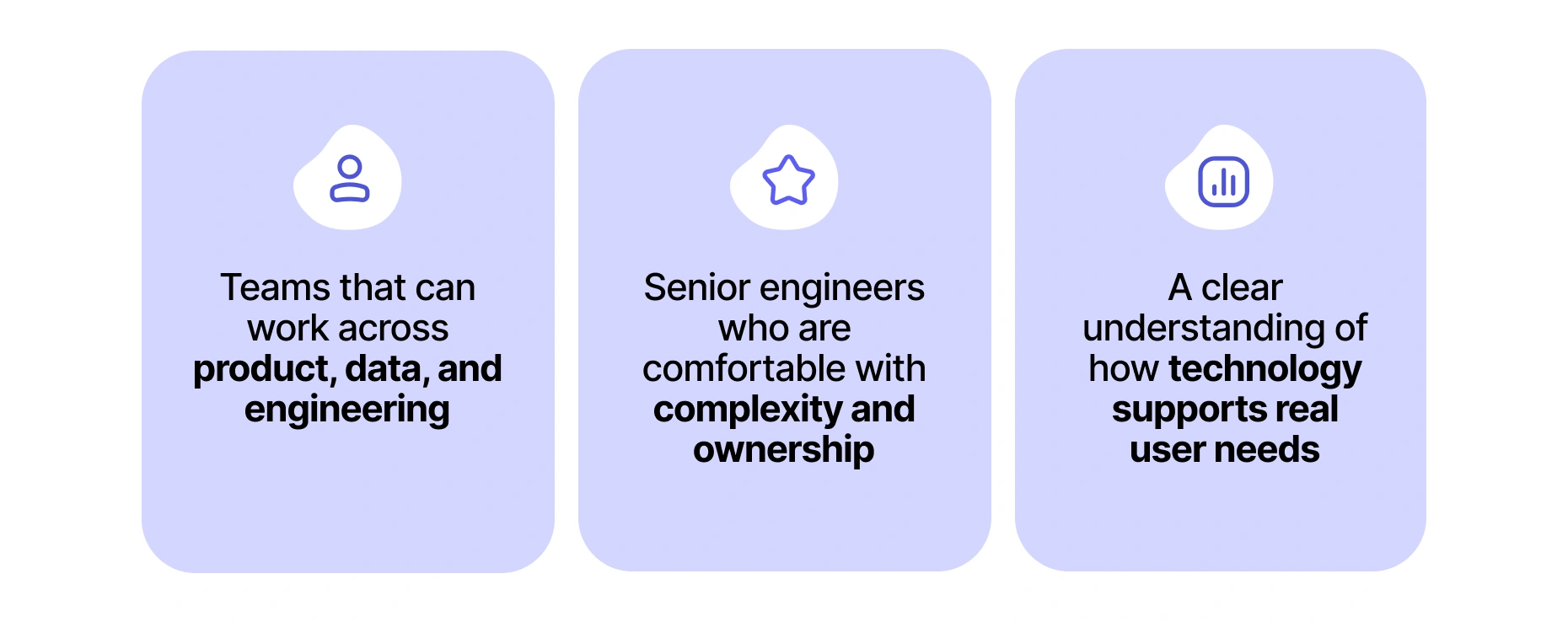
More and more, the advantage isn’t having the best idea, it’s having the right people in place to build, iterate, and improve it over time.
And that’s where flexible team models and access to specialized talent are becoming part of the healthcare transformation story, not as buzzwords, but as a practical way to turn innovation into something that actually works.
Wrapping up
AI in healthcare isn’t a single technology or product. It’s an evolving ecosystem of tools that are gradually changing how care is delivered, supported, and scaled.
The organizations leading this shift aren’t always the ones with the most advanced algorithms. More often, they’re the ones that manage to align technology, people, and execution in a way that’s sustainable over time. AI in healthcare is already creating value, but scaling that value requires more than strong ideas or validated models, it requires consistent execution.
As an Account Executive at Devlane, I see this firsthand in my conversations with healthcare leaders, product teams, and partners. The challenge rarely starts with whether AI can work, it’s about how to build, integrate, and scale it inside real products, without slowing teams down or adding operational friction.
That execution depends on having the right engineering capacity in place. Teams need experienced engineers who can integrate AI into existing systems, work within regulated environments, and support long-term product evolution rather than one-off implementations.
At Devlane, we work alongside companies across the healthcare industry to support that execution, by embedding senior engineers into existing teams and handling the operational complexity around building and managing distributed teams.
If any of this sounds familiar, and your team is navigating how to build or scale the right technical capabilities for healthcare or AI-driven initiatives, I’m always open to a conversation to exchange perspectives and share what we’ve seen work.

Other Blog Posts

gRPC vs REST: Performance, Architecture, and Use Cases

.webp)