ChatGPT: Different uses and examples

What is ChatGPT?
ChatGPT is an artificial intelligence-powered natural language processing tool that facilitates lifelike discussions with chatbots. You can ask the language model questions and have it help you with things like writing emails, articles, and code. Since its launch, ChatGPT has evolved into one of the most widely adopted AI tools in the world, used by individuals and organizations to support everything from writing and research to software development and business operations.
How does ChatGPT work?
ChatGPT is built on OpenAI’s family of large language models (LLMs), which are trained on vast amounts of text and continuously improved through machine learning, reinforcement learning, and human feedback. These models can understand context, generate human-like responses, summarize information, assist with problem-solving, and support a wide range of business and productivity tasks. Companies looking to turn these capabilities into production-ready products can work with specialized teams offering AI development services.
According to OpenAI, ChatGPT's capabilities are improved through a process called reinforcement learning, which depends on human feedback. OpenAI improves ChatGPT through a combination of model training, human feedback, safety testing, and ongoing system updates designed to make responses more useful and reliable.
Trainers evaluate the quality of the responses given by ChatGPT based on how closely they resemble human responses and use this information to promote human-like conversational methods.
What kinds of things can you make using ChatGPT?
The following are some of the additional functions that can be performed using ChatGPT in addition to answering human questions:
- Code and bug: ChatGPT can process, write, and debug codes. The tool may generate SQL queries. Data scientists need SQL skills; thus, using ChatGPT to improve them will boost your career.
- Data Analysis and Organization: ChatGPT can help structure information, organize datasets, generate formulas, explain queries, and assist with data-related tasks. While it is not a replacement for specialized analytics tools, it can help professionals work with information more efficiently.
- Teach as a tutor: ChatGPT explains language, code, and physics well. As ChatGPT's AI tutoring skills improve, it can change how students engage with the outside world. ChatGPT will also affect education tech. Many edtech businesses can now teach topic basics and use ChatGPT to answer student inquiries.
- Create content: Create Content ChatGPT can quickly write content from a prompt, and the AI may write a song at a user's request. ChatGPT can help users draft content, refine ideas, improve clarity, and accelerate the writing process across a variety of formats.
- AI-Assisted Creativity: ChatGPT can support creative workflows by helping generate ideas, draft creative briefs, write image prompts, and collaborate with image and video generation tools. Together, these technologies are expanding how teams approach design, content creation, and visual storytelling.
Uses of ChatGPT
How can a business use ChatGPT for content marketing?
By leveraging advanced language models and natural language processing capabilities, businesses may create exciting and pertinent content for their target audience. Businesses may use ChatGPT to develop content customized to their audience's unique requirements and interests, increasing the likelihood that it will engage and capture their interest.
Additionally, ChatGPT can aid with content research and curation from various sources, assisting companies in developing a consistent and effective content marketing strategy. Content marketers must comprehend how ChatGPT can help with content creation and curation. ChatGPT can produce exciting and pertinent material based on input and user preferences thanks to its ability to understand context, generate content, and adapt to user needs.
By creating content specifically for their target audience, content marketers can increase interaction and drive traffic to their websites or social media platforms.
Medical Use Cases of ChatGPT
Let's look at how it can help in medical use.
1. Assist with summarizing medical documentation, research papers, and administrative information. These outputs can help save time, but they should always be reviewed by qualified healthcare professionals before being used in clinical settings.
2. Analyzing and summarizing research papers. ChatGPT can assist with summarizing scientific literature, highlighting key findings, and making complex information more accessible. It can help professionals save time when reviewing large volumes of research.
3. Composing generic texts. For example, emails, a book blurb, or anything else that saves you time and may be further customized to meet your requirements and reflect your unique style. It can help draft emails, patient communications, and administrative content, which can then be reviewed and customized by healthcare professionals.
4. Respond to general inquiries. In several areas, ChatGPT provides broad, generic answers. Your questions will be answered generically, and the fundamentals will be accurate, but you'll unlikely be able to learn the specifics. The algorithm describes what an artificial pancreas is and how it functions, but it can't advise you on specific technical issues. In a similar vein, it provides a fantastic overview of the objective of my favorite board game. Still, it cannot offer a straightforward affirmative or no response to an evident but unique gaming circumstance.
5. Serve as a chatbot for the medical center's frequently asked questions (FAQ) section or appointment scheduling. Organizations can use AI-powered assistants to help answer frequently asked questions, support appointment scheduling, and improve access to information. Human oversight remains important, especially in healthcare environments.
Everyday Productivity Uses of ChatGPT
Beyond specialized use cases, many professionals use ChatGPT as a daily productivity tool. Common applications include:
- Summarizing meeting notes and long documents
- Drafting emails and business communications
- Brainstorming ideas and solving problems
- Research support and information gathering
- Creating outlines, presentations, and reports
- Organizing and structuring information
By reducing time spent on repetitive tasks, ChatGPT allows professionals to focus on higher-value work that requires human judgment and expertise.
How Businesses Can Leverage ChatGPT
From startups to global corporations, ChatGPT is quickly becoming a critical asset in business strategy.
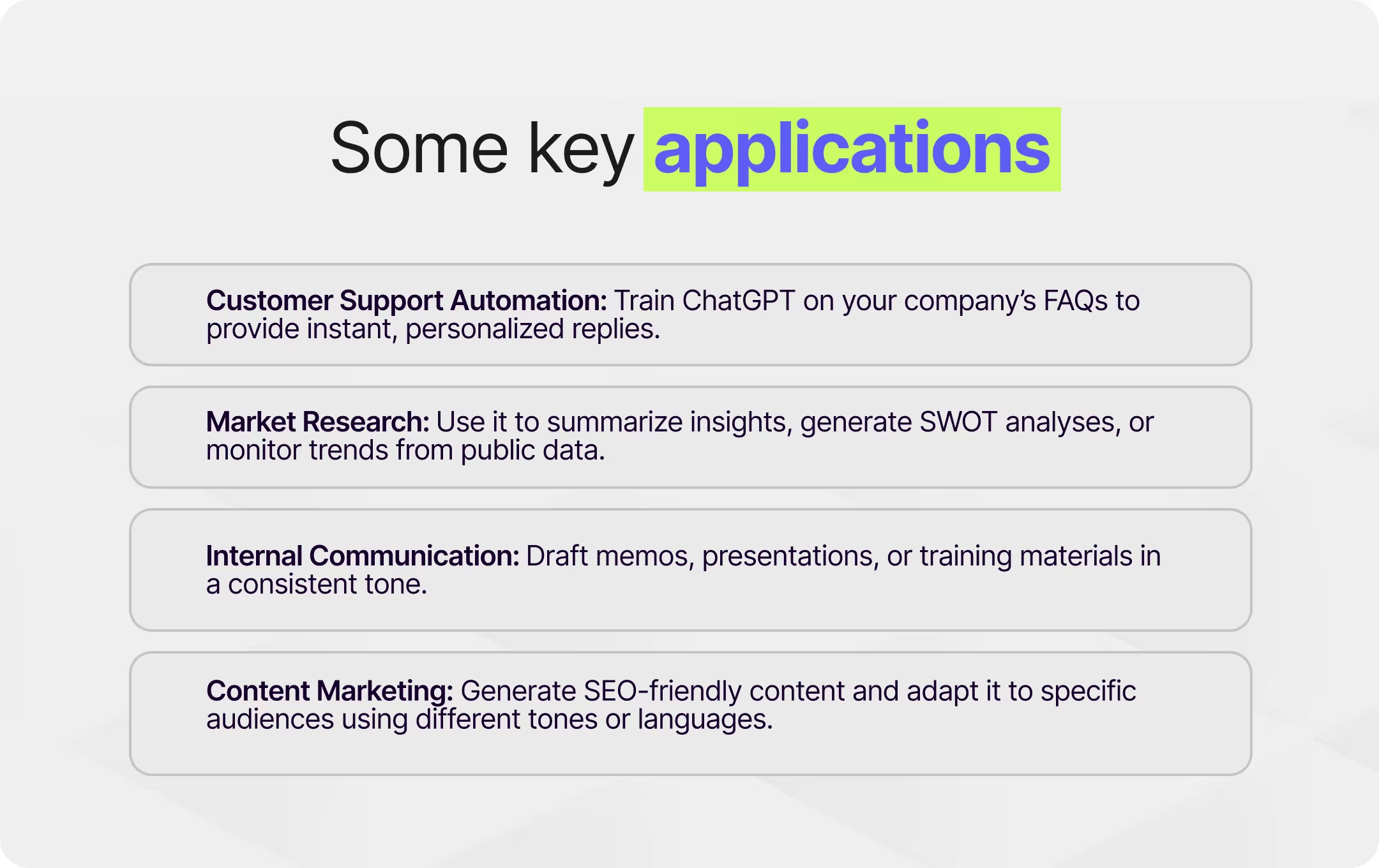
Companies adopting ChatGPT report time savings of up to 60% in content workflows and notable increases in response speed and customer engagement.
However, it’s essential to establish AI governance policies, ensuring employees check the information generated before publishing or sharing. AI should augment human expertise, not replace it. This same principle applies when companies integrate machine learning and AI solutions into their products, workflows, and decision-making processes.
ChatGPT Best Practices for Businesses
As organizations adopt AI tools more broadly, it's important to establish clear guidelines for their use. Some recommended practices include:
- Use ChatGPT to accelerate work, not replace expertise.
- Review AI-generated content before publishing or sharing it.
- Avoid entering confidential or sensitive information unless approved by company policies.
- Combine AI outputs with human judgment and domain expertise.
- Establish governance and training guidelines for employees using AI tools.
Organizations that successfully integrate AI into their workflows typically view it as a productivity enhancer rather than a complete replacement for human decision-making.
Why ChatGPT Is changing work as we Know it
The rise of ChatGPT demonstrates how large language models are reshaping both productivity and creativity. For professionals, it offers a way to accelerate tedious tasks, explore new ideas, and improve communication. For businesses, it represents a scalable tool for automation and insight generation.
Beyond productivity gains, ChatGPT reflects a big shift in how people interact with technology. AI is increasingly becoming a collaborative tool that helps individuals and teams work more efficiently, make better decisions, and unlock new opportunities for innovation. You can explore this evolution further in our article on the future of artificial intelligence and machine learning.
The conversation around ChatGPT has evolved significantly. What began as a chatbot is now becoming part of broader AI workflows that include coding assistants, enterprise search, knowledge management systems, and AI agents. Organizations that learn how to combine these tools with human expertise are likely to gain the greatest advantage as AI adoption continues to accelerate. For companies that need to add AI, machine learning, data, or backend expertise to an existing team, staff augmentation services can provide specialized talent without slowing down internal hiring.
Conclusion
ChatGPT is more than just a chatbot, it’s a multifunctional AI assistant capable of enhancing work, learning, and creativity. From writing and coding to customer service and storytelling, its impact spans nearly every industry.
Whether you’re a developer experimenting with prompts, a teacher using it for tutoring, or a business leader optimizing operations, ChatGPT offers the potential to save time, boost efficiency, and open new creative horizons.The key is to use it thoughtfully: craft detailed prompts, check the information it provides, and combine its speed with human insight.


Other Blog Posts
.webp)
How to Build an AI Agent for Production